

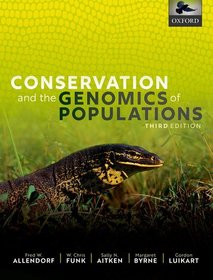
Conservation and the Genomics of Populations
- Publisher's listprice GBP 56.00
-
25 284 Ft (24 080 Ft + 5% VAT)
The price is estimated because at the time of ordering we do not know what conversion rates will apply to HUF / product currency when the book arrives. In case HUF is weaker, the price increases slightly, in case HUF is stronger, the price goes lower slightly.
- Discount 10% (cc. 2 528 Ft off)
- Discounted price 22 756 Ft (21 672 Ft + 5% VAT)
Subcribe now and take benefit of a favourable price.
Subscribe
25 284 Ft

Availability
Estimated delivery time: In stock at the publisher, but not at Prospero's office. Delivery time approx. 3-5 weeks.
Not in stock at Prospero.
Why don't you give exact delivery time?
Delivery time is estimated on our previous experiences. We give estimations only, because we order from outside Hungary, and the delivery time mainly depends on how quickly the publisher supplies the book. Faster or slower deliveries both happen, but we do our best to supply as quickly as possible.
Product details:
- Edition number 3
- Publisher OUP Oxford
- Date of Publication 15 February 2022
- ISBN 9780198856573
- Binding Paperback
- No. of pages672 pages
- Size 248x190x38 mm
- Weight 1686 g
- Language English
- Illustrations 321 colour line figures/illustrations and 43 tables 179
Categories
Short description:
The third edition of this established textbook provides an updated and comprehensive overview of the essential background, concepts, and tools required to understand how genetics can be used to conserve species, reduce threat of extinction, and manage species of ecological or commercial importance.
MoreLong description:
The relentless loss of biodiversity is among the greatest problems facing the world today. The third edition of this established textbook provides an updated and comprehensive overview of the essential background, concepts, and tools required to understand how genetics can be used to conserve species, reduce threat of extinction, and manage species of ecological or commercial importance. This edition is thoroughly revised to reflect the major contribution of genomics to conservation of populations and species. It includes two new chapters: "Genetic Monitoring" and a final "Conservation Genetics in Practice" chapter that addresses the role of science and policy in conservation genetics.
New genomic techniques and statistical analyses are crucial tools for the conservation geneticist. This accessible and authoritative textbook provides an essential toolkit grounded in population genetics theory, coupled with basic and applied research examples from plants, animals, and microbes. The book examines genetic and phenotypic variation in natural populations, the principles and mechanisms of evolutionary change, evolutionary response to anthropogenic change, and applications in conservation and management.
Conservation and the Genomics of Populations helps demystify genetics and genomics for conservation practitioners and early career scientists, so that population genetic theory and new genomic data can help raise the bar in conserving biodiversity in the most critical 20 year period in the history of life on Earth. It is aimed at a global market of applied population geneticists, conservation practitioners, and natural resource managers working for wildlife and habitat management agencies. It will be of particular relevance and use to upper undergraduate and graduate students taking courses in conservation biology, conservation genetics, and wildlife management.
This textbook is foremost a great reference for upper level undergraduate or graduate courses, as well as a good go-to reference for conservation genetic professionals. As a teaching resource, the plentiful boxes and guest boxes that present recent literature and contextual examples provide great platforms for student discussion and improved comprehension.
Table of Contents:
Preface
PART I: INTRODUCTION
Introduction
Phenotypic Variation in Natural Populations
Genetic Variation in Natural Populations
Population Genomics
PART II: MECHANISMS OF EVOLUTIONARY CHANGE
Random Mating Populations: Hardy-Weinberg Principle
Small Populations and Genetic Drift
Effective Population Size
Natural Selection
Population Subdivision
Beyond Individual Loci
Quantitative Genetics
Mutation
PART III: EVOLUTIONARY RESPONSE TO ANTHROPOGENIC CHANGES
Hybridization
Invasive Species
Exploited Populations
Climate Change
PART IV: CONSERVATION AND MANAGEMENT
Inbreeding Depression
Demography and Extinction
Population Connectivity
Units of Conservation
Conservation Breeding and Restoration
Genetic Identification
Genetic Monitoring
Conservation Genetics in Practice
Glossary
COMPANION WEBSITE MATERIALS (Available at www.oup.com/companion/AllendorfCGP3e
Appendix: Probability, Statistics, and Coding
References

