

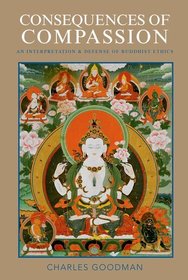
Consequences of Compassion
An Interpretation and Defense of Buddhist Ethics
- Publisher's listprice GBP 47.99
-
21 667 Ft (20 635 Ft + 5% VAT)
The price is estimated because at the time of ordering we do not know what conversion rates will apply to HUF / product currency when the book arrives. In case HUF is weaker, the price increases slightly, in case HUF is stronger, the price goes lower slightly.
- Discount 10% (cc. 2 167 Ft off)
- Discounted price 19 500 Ft (18 572 Ft + 5% VAT)
Subcribe now and take benefit of a favourable price.
Subscribe
21 667 Ft

Availability
printed on demand
Why don't you give exact delivery time?
Delivery time is estimated on our previous experiences. We give estimations only, because we order from outside Hungary, and the delivery time mainly depends on how quickly the publisher supplies the book. Faster or slower deliveries both happen, but we do our best to supply as quickly as possible.
Product details:
- Publisher OUP USA
- Date of Publication 25 September 2014
- ISBN 9780190205324
- Binding Paperback
- No. of pages264 pages
- Size 231x152x17 mm
- Weight 386 g
- Language English 0
Categories
Short description:
This book examines the theoretical structure of Buddhist accounts of morality, defends them against objections, and discusses their implications for free will, the justification of punishment, and other issues.
MoreLong description:
For many Westerners, the most appealing teachings of the Buddhist tradition pertain to ethics. Buddhist ethical views have much in common with certain modern ethical theories, and contain many insights relevant to contemporary moral problems. In Consequences of Compassion, Charles Goodman illuminates the relationship between Buddhism and Western ethical theories. Buddhist texts offer an interesting approach to the demands of morality and a powerful critique of what we would identify as the concept of free will-a critique which leads to a hard determinist view of human action. But rather than being a threat to morality, this view supports Buddhist values of compassion, nonviolence and forgiveness, and leads to a more humane approach to the justification of punishment. Drawing on Buddhist religious values, Goodman argues against the death penalty and mandatory minimum sentences.
Every version of Buddhist ethics, says Goodman, takes the welfare of sentient beings to be the only source of moral obligations. Buddhist ethics can thus be said to be based on compassion in the sense of a motivation to pursue the welfare of others. On this interpretation, the fundamental basis of the various forms of Buddhist ethics is the same as that of the welfarist members of the family of ethical theories that analytic philosophers call "consequentialism." Goodman uses this hypothesis to illuminate a variety of questions. He examines the three types of compassion practiced in Buddhism and argues for their implications for important issues in applied ethics. Goodman argues that the Buddhist tradition can and will ultimately make important contributions to contemporary global conversations about ethical issues while placing Buddhist views into the mainstream of current ethical analysis.
Table of Contents:
Introduction
1. Fundamental Buddhist Teachings
2. Main Features of Some Western Ethical Theories
3. Theravada Ethics as a Rule-Consequentialism
4. Mahayana Ethics before Santideva
5. Santideva and After
6. Transcending Ethics
7. Buddhist Ethics and the Demands of Consequentialism
8. Buddhism on Moral Responsibility
9. Punishment
10. Objections and Replies
11. A Buddhism Response to Kant
Conclusion
Notes
Bibliography
Index

