

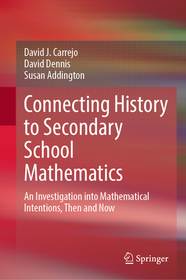
Connecting History to Secondary School Mathematics
An Investigation into Mathematical Intentions, Then and Now
- Publisher's listprice EUR 90.94
-
35 521 Ft (33 829 Ft + 5% VAT)
The price is estimated because at the time of ordering we do not know what conversion rates will apply to HUF / product currency when the book arrives. In case HUF is weaker, the price increases slightly, in case HUF is stronger, the price goes lower slightly.
- Discount 20% (cc. 7 104 Ft off)
- Discounted price 28 416 Ft (27 063 Ft + 5% VAT)
- Discount is valid until: 30 June 2026
Subcribe now and take benefit of a favourable price.
Subscribe
31 258 Ft

Availability
Not yet published.
Why don't you give exact delivery time?
Delivery time is estimated on our previous experiences. We give estimations only, because we order from outside Hungary, and the delivery time mainly depends on how quickly the publisher supplies the book. Faster or slower deliveries both happen, but we do our best to supply as quickly as possible.
Product details:
- Publisher Springer Nature Switzerland
- Date of Publication 22 May 2026
- ISBN 9783032062185
- Binding Hardback
- No. of pages366 pages
- Size 235x155 mm
- Language English
- Illustrations XXXVI, 366 p. 200 illus. 700
Categories
Long description:
This book provides a focused socio-historical analysis of the secondary mathematics curriculum, revealing how science and cultural factors influenced the genesis of many core mathematical ideas. The authors explore why certain concepts became foundational and why their original intentions matter. While seemingly epic in scope, the history provided here is more accessible than one might suspect. Much of the curriculum has its genesis in a rather narrow piece of social history and culture: Europe in the 1600s and the Scientific Revolution. Why history? Because intentions matter in mathematics and education, especially when a mandatory curriculum is tied to high-stakes testing. The authors' historical research reveals mathematics as a powerful, utilitarian approach to science, technology, and engineering. By studying the genesis of mathematical knowledge, the authors identify pathways for both practitioners and researchers to redesign curriculum and instruction in secondary and post-secondary STEM education. By discussing how old ideas could become new again, the authors argue that educators can gain deeper insight into the nature of mathematical reasoning and problem-solving, providing clarity on the complex relationship between mathematics, its history, and the future of STEM education.
MoreTable of Contents:
1. How Did We Get Here (and Where Should We Go)?.- 2. What Did Mathematicians in the 1600s Know?.- 3. Measuring the Immeasurable – Galileo and the Invention of Scientific Discovery.- 4. Flattening Apollonius.- 5. Euclid Fades Away – The Geometry of René Descartes.- 6. Algebra That Makes You Think -- The Code of John Wallis.- 7. On the Shoulders of a Giant -- The Rigorous Intellect of Isaac Newton.- 8. Gottfried W. Leibniz and the Future of Science.- 9. Coming Full Circle--The Science of Trigonometry and the Complex Numbers.- 10. Euler's Enduring Legacy -- From Practicality to Pedagogical Imperative.- 11. Reclaiming Mathematical Intentions -- Bridging History and the Modern Curriculum.
More
