

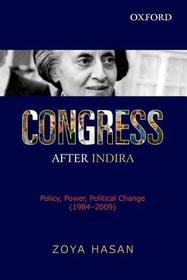
Congress after Indira
Policy, Power, Political Change (1984-2009)
- Publisher's listprice GBP 27.50
-
12 416 Ft (11 825 Ft + 5% VAT)
The price is estimated because at the time of ordering we do not know what conversion rates will apply to HUF / product currency when the book arrives. In case HUF is weaker, the price increases slightly, in case HUF is stronger, the price goes lower slightly.
- Discount 10% (cc. 1 242 Ft off)
- Discounted price 11 175 Ft (10 643 Ft + 5% VAT)
Subcribe now and take benefit of a favourable price.
Subscribe
12 416 Ft

Availability
Uncertain availability. Please turn to our customer service.
Why don't you give exact delivery time?
Delivery time is estimated on our previous experiences. We give estimations only, because we order from outside Hungary, and the delivery time mainly depends on how quickly the publisher supplies the book. Faster or slower deliveries both happen, but we do our best to supply as quickly as possible.
Product details:
- Publisher OUP India
- Date of Publication 18 October 2012
- ISBN 9780195685978
- Binding Hardback
- No. of pages304 pages
- Size 215x167x22 mm
- Weight 442 g
- Language English 0
Categories
Short description:
This book provides a thematic account of political processes and discursive policy practices and shifts which shaped the thinking and approach of the Indian National Congress. It assesses the impact of transformation in economy, society, and polity on the Congress. The volume interprets the politics of change in India, and how this developed Congress policies, especially under the United Progressive Alliance.
MoreLong description:
The Indian National Congress (INC) has played a pivotal role in nation building in India's political history. Congress after Indira provides an interpretation of contemporary Congress politics and the challenges it has faced due to the political and economic change, both nationally and globally. The book provides an insight into the structure and direction of change within the INC, and the governance agenda essentially with respect to economy, society, polity, and leadership-after
Indira Gandhi.
The volume talks about the Ayodhya issue, the phase of economic liberalization, and the comeback of the Congress as a ruling party in 2004, as a coalition government for the first time. It also discusses the dualist structure of leadership and how this has shaped the perception of the masses regarding the party.
Table of Contents:
Acknowledgements
List of Abbreviations
Introduction
Ayodhya and the Politics of Religion
Economic Liberalization and Its Discontents
Regime Change and Working the Coalition
Two-Power Centres and Government-Party Relations
Coping with Inequalities
Defending Livelihoods
Co-opting the Minorities
India-US Nuclear Deal and Great Power Ambitions
Conclusion
Bibliography
Index

