

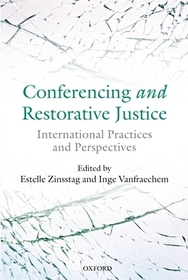
Conferencing and Restorative Justice
International Practices and Perspectives
- Publisher's listprice GBP 78.00
-
35 217 Ft (33 540 Ft + 5% VAT)
The price is estimated because at the time of ordering we do not know what conversion rates will apply to HUF / product currency when the book arrives. In case HUF is weaker, the price increases slightly, in case HUF is stronger, the price goes lower slightly.
- Discount 10% (cc. 3 522 Ft off)
- Discounted price 31 695 Ft (30 186 Ft + 5% VAT)
Subcribe now and take benefit of a favourable price.
Subscribe
35 217 Ft

Availability
printed on demand
Why don't you give exact delivery time?
Delivery time is estimated on our previous experiences. We give estimations only, because we order from outside Hungary, and the delivery time mainly depends on how quickly the publisher supplies the book. Faster or slower deliveries both happen, but we do our best to supply as quickly as possible.
Product details:
- Publisher OUP Oxford
- Date of Publication 22 November 2012
- ISBN 9780199655038
- Binding Hardback
- No. of pages266 pages
- Size 236x162x23 mm
- Weight 560 g
- Language English
- Illustrations 10 illustrations 0
Categories
Short description:
With contributions from some of the leading figures in the restorative justice community, both practitioners and academics, this book offers an analysis of conferencing practices around the world, examining the range of approaches to different types of crimes and offender age groups, and assessing their outcomes.
MoreLong description:
Conferencing and Restorative Justice: International Practices and Perspectives offers an analysis of conferencing practices around the world, examining the range of approaches to different types of crimes and offender age groups, and assessing their outcomes.
First developed in New Zealand and Australia in the 1990s, conferencing is a restorative justice practice which has since spread to a number of other countries as an effective tool in crime reduction. By encouraging the offender, the victim(s) and family members, and a facilitator to meet and discuss the crime and its consequences, and then to find a just and acceptable outcome for all, those involved hope to repair the harm inflicted upon the victim, the community and society in general. In this book, the editors have drawn together some of the leading figures in the restorative justice community to look at the current condition of such practices, particularly internationally, and to analyse the processes and outcomes of conferencing, compared with the European-favoured, victim-offender mediation.
With fourteen chapters featuring a mix of contributors, including both practitioners and academics, the book begins with a general and thematic overview of what conferencing is and how it is developing theoretically and in practice. This discussion then moves on to some of the original models of conferencing, such as in New Zealand and Australia, and examines some of the challenges (sexual assault cases) and the newer developments found in conferencing in Latin-America. The final section of the book consists of European perspectives on conferencing, exploring how some countries have developed conferencing more extensively (such as into the juvenile justice system), others are still in a starting-phase, whilst some have move conferencing outside of the justice system entirely. Impeccably researched and thoughtfully presented, Conferencing and Restorative Justice will be of interest to anyone involved in restorative justice practices, criminal justice and public policy.
Table of Contents:
Conferencing: Setting the scene
Part 1: Conferencing: Broadening the scope of restorative justice
Conferencing: A developing restorative justice practice
The need for clarity about restorative justice conferences
Comparing conferencing and mediation: Some evaluation results internationally
'That's how the light gets in': Facilitating restorative conferences
Conferencing and victims
Part 2: Conferencing: Inception, challenges, and newer developments
Revolution, decline, and renewal: Restorative youth justice in New Zealand
Conferences and gendered violence: Practices, politics, and evidence
Decentralization and privatization: The promise and challenges of restorative justice in the United States
Conferencing in South America as an exercise of democracy? An exploration of the 'vertical' role of restorative justice
Part 3: Conferencing: European perspectives
Conferencing in Northern Ireland: Implementing restorative justice at the core of the criminal justice system
Conferencing at the crossroads between rehabilitation and restorative justice
Restorative justice in the welfare state: Conferencing in the Nordic countries
Most things look better when arranged in a circle - Family Group Conferencing empowers societal developments in The Netherlands
Conferencing: Conclusions and way forward

