

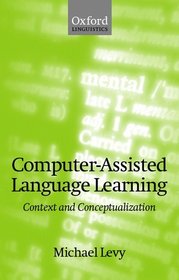
Computer-Assisted Language Learning
Context and Conceptualization
- Publisher's listprice GBP 55.00
-
26 276 Ft (25 025 Ft + 5% VAT)
The price is estimated because at the time of ordering we do not know what conversion rates will apply to HUF / product currency when the book arrives. In case HUF is weaker, the price increases slightly, in case HUF is stronger, the price goes lower slightly.
- Discount 10% (cc. 2 628 Ft off)
- Discounted price 23 649 Ft (22 523 Ft + 5% VAT)
Subcribe now and take benefit of a favourable price.
Subscribe
26 276 Ft

Availability
printed on demand
Why don't you give exact delivery time?
Delivery time is estimated on our previous experiences. We give estimations only, because we order from outside Hungary, and the delivery time mainly depends on how quickly the publisher supplies the book. Faster or slower deliveries both happen, but we do our best to supply as quickly as possible.
Product details:
- Publisher Clarendon Press
- Date of Publication 20 March 1997
- ISBN 9780198236313
- Binding Paperback
- No. of pages320 pages
- Size 217x137x17 mm
- Weight 440 g
- Language English
- Illustrations line figures, tables 0
Categories
Short description:
Michael Levy gives a comprehensive overview of the field including historical and interdisciplinary perspectives. He looks at the relationship between the theory and application of Computer-Assisted Language Learning. Describes how the computer is conceptualized as both tutor and tool, and discusses the implications for computer programming, language teaching, and learning.
MoreLong description:
So far the development of Computer-Assisted Language Learning (CALL) has been fragmented. The points of departure for CALL projects have been enormously varied, and when the projects have been written up, they rarely refer to those that have gone before. Michael Levy addresses this shortcoming, setting CALL work into a context, both historical and interdisciplinary. He is the first person in the field to consider CALL as a body of work. He also aims to identify themes and patterns of development that relate contemporary CALL to earlier projects.
The author goes on to explore how CALL practitioners have conceptualized the use of the computer in language teaching and learning. He achieves this through a detailed review of the literature, and through the results of an international CALL survey, where key CALL practitioners from 18 countries respond to questions on aspects of CALL materials development. Drawn from this rich source of information on actual CALL practice, Michael Levy analyses and expands on a tutor-tool framework. He shows this to be of value for a better understanding of methodology, integration of CALL into the curriculum, the role of the teacher and learner, and evaluation.
This is an important new book, providing much needed perspectives on the progress of CALL to date, and laying a foundation for a reconsideration of the theoretical and pedagogical frameworks of this challenging field.

