

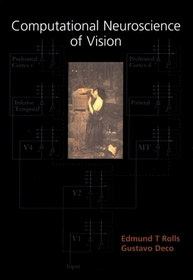
Computational Neuroscience of Vision
- Publisher's listprice GBP 137.50
-
62 081 Ft (59 125 Ft + 5% VAT)
The price is estimated because at the time of ordering we do not know what conversion rates will apply to HUF / product currency when the book arrives. In case HUF is weaker, the price increases slightly, in case HUF is stronger, the price goes lower slightly.
- Discount 10% (cc. 6 208 Ft off)
- Discounted price 55 873 Ft (53 213 Ft + 5% VAT)
Subcribe now and take benefit of a favourable price.
Subscribe
62 081 Ft

Availability
printed on demand
Why don't you give exact delivery time?
Delivery time is estimated on our previous experiences. We give estimations only, because we order from outside Hungary, and the delivery time mainly depends on how quickly the publisher supplies the book. Faster or slower deliveries both happen, but we do our best to supply as quickly as possible.
Product details:
- Publisher OUP Oxford
- Date of Publication 1 November 2001
- ISBN 9780198524892
- Binding Hardback
- No. of pages588 pages
- Size 248x175x36 mm
- Weight 1202 g
- Language English
- Illustrations numerous figures 0
Categories
Short description:
This exciting new book presents a highly complex subject of vision, focussing on the visual information processing and computational operations in the visual system that lead to representations of objects in the brain. In addition to visual processing, it also considers how visual imputs reach and are involved in the computations underlying a wide range of behaviour, thus providing a foundation for understanding the operation of a number of different brain systems. This fascinating book will be of value to all those interested in understanding how the brain works, and in understanding vision, attention, memory, emotion, motivation and action.
MoreLong description:
The Computational Neuroscience of Vision focuses on the visual information processing and computational operations in the visual system that lead to representations of objects in the brain. Chapters 1-6, describe the structure and function of many of the cortical areas invovlved in this visual processing, including the temporal lobe cortical visual areas where representations of objects are found. Chapter 7 describes the operation of neural networks that provide a foundation for understanding how some of the computations involved take place in cortical areas. Chapter 8 describes different computational approaches to the recognition of objects, and then develops a computational approach to understanding how the visual system actually forms representations of objects. Chapters 9-11 provide a computational approach to understanding how attention operates in the brain. In addition to purely visual processing, Computational Neuroscience of Vision also considers how visual inputs reach and are involved in the computations underlying a range of behaviours, including short-term memory, long-term memory, emotion and motivation, and the initiation of action. The book thus provides a foundation for understanding the operation of a number of different brain systems. This book is relatively unique in integrating evidence from the neurophysiology, neuroimaging, and neuropsychology of the high-level visual processing systems in the brain and their connected output systems with a computational framework based on biologically plausible neural networks. The book will be of value to all those interested in understanding how the brain works, and in understanding vision, attention, memory, emotion, motiviation, and action.
Computational Neuroscience of Vision provides encouraging indications that the field itself is spawning a new form of neurobiologist in which experimentalist and theorist share the same brain.
Table of Contents:
Preface
Introduction
The primary visual cortex
Extrastriate visual areas
The parietal cortex
Inferior temporal cortical visual areas
Visual attentional mechanisms
Neural network models
Models of invariant object recognition
The cortical neurodynamics of visual attention - a model
Visual search: Attentional neurodynamics at work
A computational approach to the neuropsychology of visual attention
Outputs of visual processing
Principles and conclusions
Introduction to linear algebra for neural networks
Information theory
References
Index

