

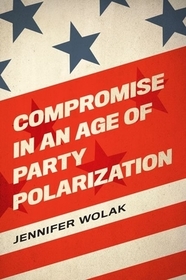
Compromise in an Age of Party Polarization
- Publisher's listprice GBP 27.49
-
13 133 Ft (12 507 Ft + 5% VAT)
The price is estimated because at the time of ordering we do not know what conversion rates will apply to HUF / product currency when the book arrives. In case HUF is weaker, the price increases slightly, in case HUF is stronger, the price goes lower slightly.
- Discount 10% (cc. 1 313 Ft off)
- Discounted price 11 819 Ft (11 256 Ft + 5% VAT)
Subcribe now and take benefit of a favourable price.
Subscribe
13 133 Ft

Availability
Estimated delivery time: Expected time of arrival: end of January 2026.
Not in stock at Prospero.
Why don't you give exact delivery time?
Delivery time is estimated on our previous experiences. We give estimations only, because we order from outside Hungary, and the delivery time mainly depends on how quickly the publisher supplies the book. Faster or slower deliveries both happen, but we do our best to supply as quickly as possible.
Product details:
- Publisher OUP USA
- Date of Publication 24 July 2020
- ISBN 9780197510506
- Binding Paperback
- No. of pages232 pages
- Size 155x231x15 mm
- Weight 340 g
- Language English 81
Categories
Short description:
In Compromise in an Age of Party Polarization, Jennifer Wolak challenges conventional wisdom and argues that Americans value compromise as a way to resolve differences in times of partisan division. Using evidence from a variety of surveys and innovative experiments, she demonstrates that citizens want more from politics than just ideological representation--they also care about the processes by which disagreements are settled. This book stands as an important first step toward trying to reducing the extreme polarization that plagues our politics.
MoreLong description:
Congressional debates are increasingly defined by gridlock and stalemate, with partisan showdowns that lead to government shutdowns. Compromise in Congress seems hard to reach, but do politicians deserve all the blame? Legislators who refuse to compromise might be doing just what their constituents want them to do. In Compromise in an Age of Party Polarization, Jennifer Wolak challenges this wisdom and demonstrates that Americans value compromise in politics. Citizens want more from elected officials than just ideological representation--they also care about the processes by which disagreements are settled. Using evidence from a variety of surveys and innovative experiments, she shows the persistence of people's support for compromise across a range of settings-even when it comes at the cost of partisan goals and policy objectives. While polarization levels are high in contemporary America, our partisan demands are checked by our principled views of how we believe politics should be practiced. By underscoring this basic yet mostly ignored fact, this book stands as an important first step toward trying to reduce the extreme polarization that plagues our politics.
A willingness to compromise might be THE topic for political scientists to understand in this era of extreme polarization. Jennifer Wolak has done an absolutely masterful job with this critical, but difficult, topic.
Table of Contents:
Acknowledgements
Chapter 1: The Challenges of Compromise
Chapter 2: Public Support for Political Compromise
Chapter 3: Compromise as a Democratic Value
Chapter 4: The Bounds of Public Support for Compromise
Chapter 5: Partisan Motives and Consideration of Compromise
Chapter 6: Campaigns, Competition, and Support for Political Compromise
Chapter 7: Policymaking, Procedural Justice, and Support for Compromise
Chapter 8: Do People Want Members of Congress to Compromise?
Chapter 9: Support for Compromise in Principle and in Practice
Chapter 10: Conclusions
References
Index

