

- Publisher's listprice GBP 70.00
-
33 442 Ft (31 850 Ft + 5% VAT)
The price is estimated because at the time of ordering we do not know what conversion rates will apply to HUF / product currency when the book arrives. In case HUF is weaker, the price increases slightly, in case HUF is stronger, the price goes lower slightly.
- Discount 10% (cc. 3 344 Ft off)
- Discounted price 30 098 Ft (28 665 Ft + 5% VAT)
Subcribe now and take benefit of a favourable price.
Subscribe
33 442 Ft

Availability
printed on demand
Why don't you give exact delivery time?
Delivery time is estimated on our previous experiences. We give estimations only, because we order from outside Hungary, and the delivery time mainly depends on how quickly the publisher supplies the book. Faster or slower deliveries both happen, but we do our best to supply as quickly as possible.
Product details:
- Publisher OUP USA
- Date of Publication 2 May 2013
- ISBN 9780199967599
- Binding Hardback
- No. of pages256 pages
- Size 165x241x27 mm
- Weight 578 g
- Language English
- Illustrations 50 music examples and 26 photographs 0
Categories
Short description:
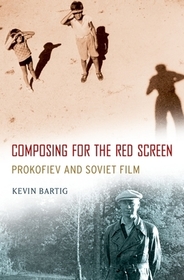
Sound film captivated Sergey Prokofiev during the final two decades of his life: he considered composing for nearly two dozen pictures, eventually undertaking eight of them, all Soviet productions. Drawing on newly available sources, Composing for the Red Screen examines - for the first time - the full extent of this prodigious cinematic career.
MoreLong description:
Sound film captivated Sergey Prokofiev during the final two decades of his life: he considered composing for nearly two dozen pictures, eventually undertaking eight of them, all Soviet productions. Hollywood luminaries such as Gloria Swanson tempted him with commissions, and arguably more people heard his film music than his efforts in all other genres combined. Films for which Prokofiev composed, in particular those of Sergey Eisenstein, are now classics of world cinema. Drawing on newly available sources, Composing for the Red Screen examines--for the first time--the full extent of this prodigious cinematic career.
Bartig examines how Prokofiev's film music derived from a self-imposed challenge: to compose "serious" music for a broad audience. The picture that emerges is of a composer seeking an individual film-music voice, shunning Hollywood models and objecting to his Soviet colleagues' ideologically expedient film songs. Looking at Prokofiev's film music as a whole--with well-known blockbusters like Alexander Nevsky considered alongside more obscure or aborted projects--reveals that there were multiple solutions to the challenge, each with varying degrees of success. Prokofiev carefully balanced his own populist agenda, the perceived aesthetic demands of the films themselves, and, later on, Soviet bureaucratic demands for accessibility.
A long-awaited, much-needed contribution to Prokofiev studies and Soviet cinema history. In Kevin Bartig's account, Alexander Nevsky, a showcase score of enduring appeal, becomes utterly fresh, and Ivan the Terrible even more compellingly bizarre. Highlights include a meticulous chronicle of the unfinished film The Queen of Spades, one of the great might-have-beens in the Soviet canon. Bartig also makes the case for the commercial (or at least educational) release of Tonya, a propagandistic film of modest musical appeal, while also filling in details of Prokofiev's service to Soviet power during the Second World War.
Table of Contents:
Acknowledgements
Editorial Matters
Abbreviations
Introduction
Chapter 1. New Media, New Means: Lieutenant Kizhe, 1932-34
Chapter 2. The Queen of Spades, The 1937 Pushkin Jubilee, and Repatriation
Chapter 3. The Year 1938: Halcyon Days in Hollywood and an Unanticipated Collaboration
Chapter 4. Alexander Nevsky and the Stalinist Museum
Chapter 5. The Wartime Films, 1940-43
Chapter 6. Ivan the Terrible and the Russian National Tradition
Epilogue
Appendix
Works cited
Index

