

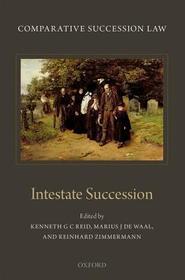
Comparative Succession Law
Volume II: Intestate Succession
- Publisher's listprice GBP 175.00
-
79 012 Ft (75 250 Ft + 5% VAT)
The price is estimated because at the time of ordering we do not know what conversion rates will apply to HUF / product currency when the book arrives. In case HUF is weaker, the price increases slightly, in case HUF is stronger, the price goes lower slightly.
- Discount 10% (cc. 7 901 Ft off)
- Discounted price 71 111 Ft (67 725 Ft + 5% VAT)
Subcribe now and take benefit of a favourable price.
Subscribe
79 012 Ft

Availability
printed on demand
Why don't you give exact delivery time?
Delivery time is estimated on our previous experiences. We give estimations only, because we order from outside Hungary, and the delivery time mainly depends on how quickly the publisher supplies the book. Faster or slower deliveries both happen, but we do our best to supply as quickly as possible.
Product details:
- Publisher OUP Oxford
- Date of Publication 27 August 2015
- ISBN 9780198747123
- Binding Hardback
- No. of pages560 pages
- Size 241x167x37 mm
- Weight 996 g
- Language English 0
Categories
Short description:
Exploring the rules that apply when a person dies without leaving a valid will, Intestate Succession delivers a comparative and historical review of the relevant law in Europe and beyond, including an analysis of legal development, justifications, and reform.
MoreLong description:
Intestate Succession is the second volume in the Comparative Succession Law series which examines the principles of succession law from a comparative and historical perspective. This volume discusses the rules which apply where a person dies either without leaving a valid will, or leaving a will which fails to dispose of all of the person's assets. Among the questions considered are the following: What is the nature of the rules for the disposal of the deceased's assets? Are they mechanical or is there an element of discretion? Are particular types of property dealt with in particular ways? Is there entitlement to individual assets (as opposed to money)? Do the rules operate in a parentelic system or a system of some other kind? Are spouses treated more favourably than children? What provision is made for extra-marital children, for adopted children, for step-children? Does cohabitation give rise to entitlement? How are same-sex couples treated? Broader questions also arise of a historical and comparative nature. Where, for example, do the rules in intestate succession come from in particular legal systems? Have they been influenced by the rules in other countries? How are the rules explained and how are they justified? To what extent have they changed over time? What are the long-term trends? And finally, are the rules satisfactory, and is there pressure for their reform?
As in the first volume, this book will focus on Europe and on countries which have been influenced by the European experience such as Australia, New Zealand, South Africa, the United States of America, Quebec, and the countries of Latin America. Further chapters are devoted to Islamic Law and Nordic law. Opening with a discussion on Roman law and concluding with an assessment of the overall development of the law in the countries surveyed, this book will provide a wider reflection on the nature and purpose of the law of intestate succession.
Table of Contents:
Intestate Succession in Roman Law
Intestate Succession in France
Intestate Succession in Quebec
Intestate Succession in Italy
Intestate Succession in Spain
Intestate Succession in Latin America
Intestate Succession in Austria
Intestate Succession in Germany
Intestate Succession in the Netherlands
Intestate Succession in South Africa
Intestate Succession in Hungary
Intestate Succession in Poland
Intestate Succession in the Nordic Counties
Intestate Succession in England and Wales
Intestate Succession in Australia and New Zealand
Intestate Succession in Scotland
Intestate Succession in the United States of America
Intestate Succession in Islamic Countries
Intestate Succession in Historical and Comparative Perspective

