

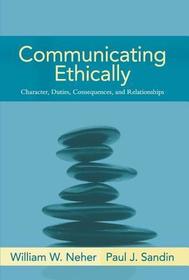
Communicating Ethically
Character, Consequences, And Relationships
-
GET 10% OFF
- Publisher's listprice GBP 70.99
-
32 051 Ft (30 525 Ft + 5% VAT)
The price is estimated because at the time of ordering we do not know what conversion rates will apply to HUF / product currency when the book arrives. In case HUF is weaker, the price increases slightly, in case HUF is stronger, the price goes lower slightly.
- Discount 10% (cc. 3 205 Ft off)
- Discounted price 28 846 Ft (27 473 Ft + 5% VAT)
28 846 Ft

Availability
Out of print
Why don't you give exact delivery time?
Delivery time is estimated on our previous experiences. We give estimations only, because we order from outside Hungary, and the delivery time mainly depends on how quickly the publisher supplies the book. Faster or slower deliveries both happen, but we do our best to supply as quickly as possible.
Product details:
- Edition number 1
- Publisher Routledge
- Date of Publication 21 March 2006
- ISBN 9780205393633
- Binding Paperback
- No. of pages368 pages
- Size 228x152 mm
- Weight 499 g
- Language English 0
Categories
Short description:
Communicating Ethically provides a broad introduction to the ethical nature of communication.
The text combines coverage of the major systems of ethical reasoning with lots of applications, including case studies in each chapter investigating ethics within many fields: interpersonal communication, organizational communication, political communication, and mass communication/media. By incorporating a simple framework for ethical reasoning, students will be able to develop their own understanding of the various criteria for making ethical judgments.
Features
- Presents an overview of the major systems of ethical reasoning and applications. Part 1 presents the major systems of ethical reasoning throughout history: virtue ethics, universalistic systems of ethics, utilitarianism and egalitarian theories of ethics, dialogic ethics, and postmodern and feminist perspectives. Part 2 covers applications of ethics in various communicative settings, so that students can see how the major systems are applied in the real world.
- Offers a case study in each chapter, illustrating principles related to the chapter topic. The case studies provide students with an opportunity to apply concepts that they learn while developing their critical thinking skills.
- Develops a capstone with the last chapter to assist instructors and students in pulling together the various themes and topics discussed throughout the text.
- Gives a framework for ethical reasoning that is easy for instructors to teach and easy for students to learn. The text borrows a model from argumentation theory - three forms of propositions: Fact, Value, and Policy - thereby allowing students to develop an understanding of the various criteria that have been formulated for making ethical judgments.
Praise for Communicating Ethically
Throughout the book, the authors had an excellent selection of examples. The examples were often from prominent incidents, and they were interesting cases to consider. I found this book to be very well written. And overall, I was very impressed ? it exceeded my expectations by a considerable margin? I strongly recommend this book.
~ Jonathan Hess, University of Missouri, Columbia
The writing style is excellent.
~ L. David Schuelke, Bethel College
Long description:
Communication Ethics provides a broad introduction to the ethical nature of communication. The book combines coverage of the major systems of ethical reasoning with lots of applications, including case studies in each chapter, to investigate ethics within many fields in the discipline: rhetoric, interpersonal communication, organizational communication, political communication, and mass communication/media. By incorporating a simple framework for ethical reasoning, the reader will be able to develop their own understanding of the various criteria for making ethical judgments.
Communication Ethics provides a broad introduction to the ethical nature of communication. The book combines coverage of the major systems of ethical reasoning with lots of applications, including case studies in each chapter, to investigate ethics within many fields in the discipline: rhetoric, interpersonal communication, organizational communication, political communication, and mass communication/media. By incorporating a simple framework for ethical reasoning, the reader will be able to develop their own understanding of the various criteria for making ethical judgments.

