

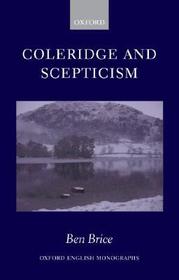
Coleridge and Scepticism
Series: Oxford English Monographs;
- Publisher's listprice GBP 79.00
-
35 668 Ft (33 970 Ft + 5% VAT)
The price is estimated because at the time of ordering we do not know what conversion rates will apply to HUF / product currency when the book arrives. In case HUF is weaker, the price increases slightly, in case HUF is stronger, the price goes lower slightly.
- Discount 10% (cc. 3 567 Ft off)
- Discounted price 32 102 Ft (30 573 Ft + 5% VAT)
Subcribe now and take benefit of a favourable price.
Subscribe
35 668 Ft

Availability
printed on demand
Why don't you give exact delivery time?
Delivery time is estimated on our previous experiences. We give estimations only, because we order from outside Hungary, and the delivery time mainly depends on how quickly the publisher supplies the book. Faster or slower deliveries both happen, but we do our best to supply as quickly as possible.
Product details:
- Publisher OUP Oxford
- Date of Publication 18 October 2007
- ISBN 9780199290253
- Binding Hardback
- No. of pages242 pages
- Size 222x145x19 mm
- Weight 428 g
- Language English 0
Categories
Short description:
Ben Brice examines Coleridge's poetry and prose between 1795 and 1825 in the context of important philosophical and theological debates with which the poet was familiar. He explores Coleridge's scepticism about his own theory of symbolism, which was so fundamental to his poetic vision, and presents a new and original account of why this anxiety and doubt was present in Coleridge's writings.
MoreLong description:
Coleridge tended to view objects in the natural world as if they were capable of articulating truths about his own poetic psyche. He also regarded such objects as if they were capable of illustrating and concretely embodying truths about a transcendent spiritual realm. After 1805, he posited a series of analogical 'likenesses' connecting the rational principles that inform human cognition with the rational principles that he believed informed the teleological structure of the natural world. Human reason and the principle of rationality realised objectively in Nature were both regarded as finite effects of God's seminal Word. Although Coleridge intuitively felt that nature had been constructed as a 'mirror' of the human mind, and that both mind and nature were 'mirrors' of a transcendent spiritual realm, he never found an explanation of such experiences that was fully immune to his own sceptical doubts.
Coleridge and Scepticism examines the nature of these sceptical doubts, as well as offering a new explanatory account of why Coleridge was unable to affirm his religious intuitions. Ben Brice situates his work within two important intellectual traditions. The first, a tradition of epistemological 'piety' or 'modesty', informs the work of key precursors such as Kant, Hume, Locke, Boyle, and Calvin, and relates to Protestant critiques of natural reason. The second, a tradition of theological voluntarism, emphasises the omnipotence and transcendence of God, as well as the arbitrary relationship subsisting between God and the created world. Brice argues that Coleridge's detailed familiarity with both of these interrelated intellectual traditions, ultimately served to undermine his confidence in his ability to read the symbolic language of God in nature.
The lucidity and rigour of Coleridge and Scepticism should recommend it not just to Coleridgeans, but to any reader interested in interactions between literature and philosophy in the long eighteenth century.
Table of Contents:
Introduction
Theological Voluntarism and Protestant Critiques of Natural Reason
Hume's 'Fork': Scepticism and Natural Religion
'That Uncertain Heaven': Coleridge's Poetry and Prose 1795 to 1805
Between Flesh and Spirit: Coleridge's Prose Writings 1815 to 1825
Conclusion

