

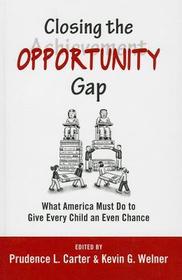
Closing the Opportunity Gap
What America Must Do to Give Every Child an Even Chance
- Publisher's listprice GBP 125.00
-
56 437 Ft (53 750 Ft + 5% VAT)
The price is estimated because at the time of ordering we do not know what conversion rates will apply to HUF / product currency when the book arrives. In case HUF is weaker, the price increases slightly, in case HUF is stronger, the price goes lower slightly.
- Discount 10% (cc. 5 644 Ft off)
- Discounted price 50 794 Ft (48 375 Ft + 5% VAT)
Subcribe now and take benefit of a favourable price.
Subscribe
56 437 Ft

Availability
printed on demand
Why don't you give exact delivery time?
Delivery time is estimated on our previous experiences. We give estimations only, because we order from outside Hungary, and the delivery time mainly depends on how quickly the publisher supplies the book. Faster or slower deliveries both happen, but we do our best to supply as quickly as possible.
Product details:
- Publisher OUP USA
- Date of Publication 30 May 2013
- ISBN 9780199982981
- Binding Hardback
- No. of pages336 pages
- Size 157x239x25 mm
- Weight 689 g
- Language English
- Illustrations 6 graphs, 6 tables 0
Categories
Short description:
Closing the Opportunity Gap offers accessible, research-based essays written by leading experts who highlight the disparities that exist in our public schools for the opportunity to learn instead of test scores and outcomes.
MoreLong description:
While the achievement gap has dominated policy discussions over the past two decades, relatively little attention has been paid to a gap that is even more at odds with American ideals: the opportunity gap. Opportunity and achievement, while inextricably connected, are very different goals. Every American will not go to college, but every American should be given fair opportunities to be prepared for college. By obsessively focusing on measuring achievement, the nation's policymakers have made little progress in measuring or addressing inequitable opportunities. Policy therefore fails to engage with the challenges, supports, and resources that lead to improvements in student learning. The achievement gap has not arisen by coincidence; children learn when they have opportunities to learn, and gaps in opportunities have led to gaps in achievement. Moreover, students' learning experiences and outcomes are deeply affected by many factors outside of the immediate control of schools.
Closing the Opportunity Gap brings together top experts who offer evidence-based essays that paint a powerful picture of denied opportunities. They also describe sensible, research-based policy approaches to enhance opportunities. They highlight the discrepancies that exist in our society and in our public schools, focusing on how policy decisions and broader circumstances conspire to create the opportunity gap that leads inexorably to the outcome differences that have become so stark. The volume makes a compelling case that American educational policy must move beyond the conventional focus on achievement and opens a discussion about the common sense ways schools can and should give all American children more equitable opportunities to thrive.
Schooling, at its best, is about creating new futures for our children. Closing the Opportunity Gap describes education as it is and provides a vision of education as it should be. The book provides a powerful critique of the educational and social policies and practices that exacerbate the widening economic disparity between rich and poor and the growing opportunity gap for too many of our nation's youth. The authors' analyses of educational inequity and their focus on opportunity to learn offer a much needed blueprint and a new social imagination about schooling in the U.S
Table of Contents:
Acknowledgements
List of Contributors
Chapter 1. Achievement Gaps Arise from Opportunity Gaps, Kevin G. Welner & Prudence L. Carter
Chapter 2. Lack of Achievement or Loss of Opportunity?, Gloria Ladson-Billings
Part One: Overcoming the Obstacles We Create for Children
Chapter 3. Educationalizing the Welfare State and Privatizing Education: The Irony of Recent School Reform, Harvey Kantor & Robert Lowe
Chapter 4. Going to the Roots: Race, Housing, and School Inequality Costs and Possible Solutions, Gary Orfield
Chapter 5. Why Children from Lower Socioeconomic Classes, on Average, Have Lower Academic Achievement than Middle-Class Children, Richard Rothstein
Part Two: Overcoming the Obstacles We Create for Schools
Chapter 6. Inequality and School Resources: What it Will Take to Close the Opportunity Gap?, Linda Darling-Hammond
Chapter 7. Achievement Gaps Start Early: Preschool Can Help, W. Steven Barnett & Cynthia E. Lamy
Chapter 8. How Common Standards and Standardized Testing Widen the Opportunity Gap, Yong Zhao & Christopher Tienken
Chapter 9. A More Perfect Union: Reconciling School Choice Policy with Equality of Opportunity Goals, Janelle Scott & Amy Stuart Wells
Part Three: Overcoming the Obstacles We Create for Teachers
Chapter 10. Student and School Cultures & the Opportunity Gap: Paying Attention and Engaging Better, Prudence L. Carter
Chapter 11. Meeting the Needs of Language Minorities, Patricia Gándara
Chapter 12. Tracking, Segregation, and the Opportunity Gap: What We Know and Why It Matters, Karolyn Tyson
Chapter 13. Good Schools and Teachers for All Students: Dispelling Myths, Facing Evidence, and Pursuing the Right Strategies, Barnett Berry
Part Four: Solutions/Conclusion
Chapter 14. The Cumulative Costs of the Opportunity Gap, Clive Belfield & Hank Levin
Chapter 15. Enhancing a Nation's Democracy through Equitable Schools, Michele Moses & John Rogers
Chapter 16. Building Opportunities to Achieve, Prudence L. Carter & Kevin G. Welner
Notes
References
Index

