

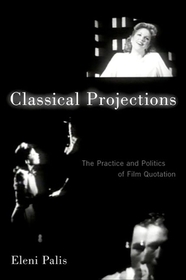
Classical Projections
The Practice and Politics of Film Quotation
- Publisher's listprice GBP 105.00
-
47 407 Ft (45 150 Ft + 5% VAT)
The price is estimated because at the time of ordering we do not know what conversion rates will apply to HUF / product currency when the book arrives. In case HUF is weaker, the price increases slightly, in case HUF is stronger, the price goes lower slightly.
- Discount 10% (cc. 4 741 Ft off)
- Discounted price 42 667 Ft (40 635 Ft + 5% VAT)
Subcribe now and take benefit of a favourable price.
Subscribe
47 407 Ft

Availability
printed on demand
Why don't you give exact delivery time?
Delivery time is estimated on our previous experiences. We give estimations only, because we order from outside Hungary, and the delivery time mainly depends on how quickly the publisher supplies the book. Faster or slower deliveries both happen, but we do our best to supply as quickly as possible.
Product details:
- Publisher OUP USA
- Date of Publication 27 May 2022
- ISBN 9780197558171
- Binding Hardback
- No. of pages180 pages
- Size 241x159x15 mm
- Weight 395 g
- Language English 207
Categories
Short description:
How does post-classical cinema visualize its awareness of coming after a "classical" or "golden age"? How do post-classical filmmakers claim or disavow classical history? How do historically disenfranchised post-classical filmmakers, whether by gender, sexuality, or race, grapple with exclusionary and stereotype-ridden canons? Classical Projections offers a new way of seeing quotations of films within other films.
MoreLong description:
Quotations are a standard way that the humanities make meaning; the pull-quote, epigraph, and quotation are standard for citing evidence and invoking and interrogating authority in both literary and scholarly writing. However, film studies has yet to seriously examine how moving images can quote one another, convening interaction and creating new knowledge across time.
Classical Projections offers "film quotation" as a new concept for understanding how preexisting moving image fragments are reframed and re-viewed within subsequent films. As a visual corollary to literary quotation, film quotations embed film fragments in on-screen movie screens. Though film quotations have appeared since silent cinema, Classical Projections focuses on quotations of classical Hollywood film--mainstream American studio production, 1915-1950--as quoted in post-classical Hollywood, roughly 1960 to present. This strategic historical frame asks: how does post-classical cinema visualize its awareness of coming after a classical or golden age? How do post-classical filmmakers claim or disavow classical history? How do historically disenfranchised post-classical filmmakers, whether by gender, sexuality, or race, grapple with exclusionary and stereotype-ridden canons?
As a constitutive element of post-classical authorship, film quotations amass and manufacture classical Hollywood in retrospective, highly strategic ways. By revealing how quotational tellings of film history build and embolden exclusionary, myopic canons, Classical Projections uncovers opportunities to construct more capacious cultural memory.
This book's solidly interdisciplinary framing sustains richly detailed research and analysis. It will speak to broad audiences across film, media, and cultural studies, as well as gender and women's studies and critical race theory. Palis's analysis takes the most subtle and incisive type of approach to questions of both the canon and authorship. Her argument bypasses more traditional, additive or inclusive canon 'revision' in favor of a radical reshaping, reframing, and re-contextualizing of the canonical history of U.S. cinema since the 'New Hollywood.
Table of Contents:
Introduction
Chapter 1: "Quoting Genre and Creating Canon"
Chapter 2: "Film Quotation and the Oppositional Gaze"
Chapter 3: "'D-I-Y' Quotation and Created Appropriation"
Chapter 4: "Film Quotation and Visual Sovereignty"
Chapter 5: "Film Quotation, Foreign and Domestic"
Chapter 6: "Cinephilic Pilgrimage and Authorial Scandal"
Annotated Appendix
Index

