

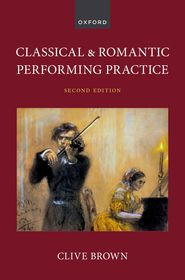
Classical and Romantic Performing Practice
- Publisher's listprice GBP 51.00
-
23 026 Ft (21 930 Ft + 5% VAT)
The price is estimated because at the time of ordering we do not know what conversion rates will apply to HUF / product currency when the book arrives. In case HUF is weaker, the price increases slightly, in case HUF is stronger, the price goes lower slightly.
- Discount 15% (cc. 0 Ft off)
- Discounted price 19 573 Ft (18 641 Ft + 5% VAT)
- Discount is valid until: 5 August 2026
Subcribe now and take benefit of a favourable price.
Subscribe
23 026 Ft

Availability
printed on demand
Why don't you give exact delivery time?
Delivery time is estimated on our previous experiences. We give estimations only, because we order from outside Hungary, and the delivery time mainly depends on how quickly the publisher supplies the book. Faster or slower deliveries both happen, but we do our best to supply as quickly as possible.
Product details:
- Edition number 2
- Publisher OUP USA
- Date of Publication 25 March 2025
- ISBN 9780197581629
- Binding Paperback
- No. of pages1076 pages
- Size 235x157x55 mm
- Weight 1533 g
- Language English
- Illustrations Over 500 music examples 573
Categories
Short description:
Drawing upon early recordings, documentary evidence, and the few surviving mechanical instruments, author Clive Brown investigates how we might rediscover the subliminal messages Classical and Romantic music notation was intended to convey to performers and argues that composers' intentions for their notation ought not to be confused with their expectations for its execution. The revised and expanded second edition incorporates new information resulting from the author's continued research and practical experimentation since 1999 and his work with a succession of talented doctoral students.
MoreLong description:
This book investigates the changing ways in which composers employed notation and musicians understood it between the middle of the eighteenth century and the start of the twentieth century. While explicit notational practices were increasingly the norm throughout this time, many aspects of performance--even as late as the late nineteenth century--were assumed rather than specified and it was still widely understood that much had to be read between the lines. Furthermore, during the twentieth century the intended implications of many previous notational practices were gradually forgotten and are now generally misunderstood, while others--such as continuous vibrato and the meticulous observance of vertical synchrony and notated rhythms--differ radically from anything the composer might have envisaged.
Drawing upon early recordings, documentary evidence, and the few surviving mechanical instruments, author Clive Brown investigates how we might rediscover the subliminal messages Classical and Romantic music notation was intended to convey to performers and argues that composers' intentions for their notation ought not to be confused with their expectations for its execution. The use of expressive practices that often involve substantial deviations from a conventional modern reading of the notation is not only a legitimate but also an essential element in getting closer to the composer's conception. The following topics are investigated over the course of sixteen chapters: metrical and rhetorical accentuation, dynamics, articulation, string-instrument bowing, phrasing, expression, tempo, tempo flexibility, ornamentation and improvisation, asynchrony, arpeggiation, rhythmic flexibility, sliding effects (portamento), and trembling effects (tremolo, vibrato). The book offers ample evidence to demonstrate that, in many respects, the sound worlds in which Mozart, Beethoven, Wagner, and Brahms created their music were more radically different from ours than is generally assumed.
After it was published in 1999, the first edition of Classical and Romantic Performing Practice 1750-1900 quickly ensconced itself as a must-read for all students, scholars, and performers in historically informed performance. The revised and expanded second edition incorporates new information resulting from the author's continued research and practical experimentation since the publication of the original edition, and has benefitted greatly from his work with a succession of talented doctoral students over the years.
This book will revolutionize the study of music...The book weaves strong patterns from the conflicting habits of different places, people and periods. It doesn't tell you exactly what to do, but inspires a confidence that your own decisions, thus informed, will work.
Table of Contents:
Introduction
1. Accentuation in Theory
2. Accentuation in Practice
3. The Notation of Accents and Dynamics
4. Articulation and Phrasing
5. Articulation and Expression
6. The Notation of Articulation and Phrasing
7. String Bowing
8. Tempo
9. Alla Breve
10. Terms of Tempo and Expression
11. Tempo Modification
12. Appoggiaturas, Trills, Turns, and Related Ornaments
13. Improvised ornamentation and Embellishment
14. Asynchrony, Arpeggiation, and Flexible Rhythm
15. Portamento and other sliding effects
16. Vibrato and other Trembling Effects
Index

