

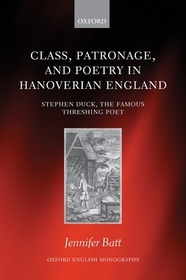
Class, Patronage, and Poetry in Hanoverian England
Stephen Duck, The Famous Threshing Poet
Series: Oxford English Monographs;
- Publisher's listprice GBP 89.00
-
40 183 Ft (38 270 Ft + 5% VAT)
The price is estimated because at the time of ordering we do not know what conversion rates will apply to HUF / product currency when the book arrives. In case HUF is weaker, the price increases slightly, in case HUF is stronger, the price goes lower slightly.
- Discount 10% (cc. 4 018 Ft off)
- Discounted price 36 165 Ft (34 443 Ft + 5% VAT)
Subcribe now and take benefit of a favourable price.
Subscribe
40 183 Ft

Availability
Estimated delivery time: In stock at the publisher, but not at Prospero's office. Delivery time approx. 3-5 weeks.
Not in stock at Prospero.
Why don't you give exact delivery time?
Delivery time is estimated on our previous experiences. We give estimations only, because we order from outside Hungary, and the delivery time mainly depends on how quickly the publisher supplies the book. Faster or slower deliveries both happen, but we do our best to supply as quickly as possible.
Product details:
- Publisher OUP Oxford
- Date of Publication 18 June 2020
- ISBN 9780198859666
- Binding Hardback
- No. of pages234 pages
- Size 236x163x20 mm
- Weight 518 g
- Language English 0
Categories
Short description:
This book explores the complex and contested relationships that existed between class, patronage, and poetry in Hanoverian England by examining the life and work of Stephen Duck, the 'famous threshing poet'. Duck's remarkable story reveals the tolerances, and intolerances, of the Hanoverian social order.
MoreLong description:
In 1730 Stephen Duck became the most famous agricultural labourer in the Hanoverian England when his writing won him the patronage of Queen Caroline. Duck and his writing intrigued his contemporaries. How was it possible for an agricultural labourer to become a poet? What would a thresher write? Did he really deserve royal patronage, and what would he do with such an honour? How should he be supported? And was he an isolated prodigy, or were there others like him, equally deserving of support?
Duck's remarkable story reveals the tolerances, and intolerances, of the Hanoverian social order. Class, Patronage, and Poetry in Hanoverian England: Stephen Duck, The Famous Threshing Poet explores these complex and contested relationships through Duck's life and work. It sheds new light on the poet's early life, revealing how the farm labourer developed an interest in poetry; how he wrote his most famous poem, 'The Thresher's Labour'; how his public identity as the 'famous Threshing Poet' took shape; and how he came to be positioned as a figurehead of labouring-class writing. It explores how the patronage Duck received shaped his writing; how he came to reconceive his relationship with land, labour, and leisure; and how he made use of his newly acquired classical learning to develop new friendships and career opportunities. Finally, it reveals how, after Duck's death, rumours about his suicide came to overshadow the achievements of his life. Both in life, and in death, this book argues, Duck provided both opportunity and provocation for thinking through the complex interplay of class, patronage, and poetry in Hanoverian England.
The first monograph devoted to working-class poet Stephen Duck (1705-56) to appear in some hundred years, Class, Patronage, and Poetry in Hanoverian England is more than a critical study of a single poet, though it is that. Batt (Univ. of Bristol, UK) also uses Duck to explore issues of class and patronage in 18th-century Britain. ... A valuable resource on 18th-century culture and poetry.
Table of Contents:
Introduction: 'All mankind would make a figure'
'A Man grown up into an Excellent Poet all at once': Making the Poet
''Tis agreeable to see what use he has made of his Reading': Writing 'The Thresher's Labour'
'From the Author's own Original Manuscript': Publishing 'the famous Threshing Poet'
'For Duck can thresh, you know, as well as write': Becoming 'the famous Threshing Poet'
'The Duty of a grateful Muse': Writing at Court
'Various Beauties overpay my Toil': Reimaging Landscape and Labour
'Too Severe on the Female Sex'?: Negotiating Class and Gender
'A very agreeable Conversation': Making Friends with Horace
'Some Gentleman-like Title, as that of The Revd': Joining the Clergy
Conclusion: 'The Bard may die - the Thresher still survive'

