

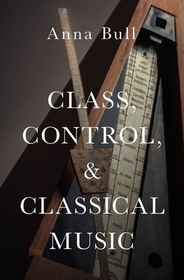
Class, Control, and Classical Music
- Publisher's listprice GBP 90.00
-
40 635 Ft (38 700 Ft + 5% VAT)
The price is estimated because at the time of ordering we do not know what conversion rates will apply to HUF / product currency when the book arrives. In case HUF is weaker, the price increases slightly, in case HUF is stronger, the price goes lower slightly.
- Discount 10% (cc. 4 064 Ft off)
- Discounted price 36 572 Ft (34 830 Ft + 5% VAT)
Subcribe now and take benefit of a favourable price.
Subscribe
40 635 Ft

Availability
Estimated delivery time: In stock at the publisher, but not at Prospero's office. Delivery time approx. 3-5 weeks.
Not in stock at Prospero.
Why don't you give exact delivery time?
Delivery time is estimated on our previous experiences. We give estimations only, because we order from outside Hungary, and the delivery time mainly depends on how quickly the publisher supplies the book. Faster or slower deliveries both happen, but we do our best to supply as quickly as possible.
Product details:
- Publisher OUP USA
- Date of Publication 18 July 2019
- ISBN 9780190844356
- Binding Hardback
- No. of pages264 pages
- Size 160x239x22 mm
- Weight 499 g
- Language English 10
Categories
Short description:
Why is classical music predominantly the preserve of the white middle classes? Through a richly detailed ethnography, this book contributes to this ongoing debate with a timely and provocative intervention, locating classical music within one of the cultures that produces it--middle-class English youth -and foregrounds classical music as bodily practice of control and restraint.
MoreLong description:
Why is classical music predominantly the preserve of the white middle classes? Contemporary associations between classical music and social class remain underexplored, with classical music primarily studied as a text rather than as a practice until recent years. In order to answer this question, this book outlines a new approach for a socio-cultural analysis of classical music, asking how musical institutions, practices, and aesthetics are shaped by wider conditions of economic inequality, and how music might enable and entrench such inequalities or work against them. This approach is put into practice through a richly detailed ethnography which locates classical music within one of the cultures that produces it - middle-class English youth - and foregrounds classical music as bodily practice of control and restraint. Drawing on the author's own background as a classical musician, this closely observed account examines youth orchestra and youth choir rehearsals as a space where young people learn the unspoken rules of this culture of weighty tradition and gendered control. It highlights how the middle-classes' habitual roles - boundary drawing around their protected spaces and reproducing their privilege through education - can be traced within the everyday spaces of classical music. These practices are camouflaged, however, by the ideology of 'autonomous art' that classical music carries.
Rather than solely examining the social relations around the music, the book demonstrates how this reproductive work is facilitated by its very aesthetic, of 'controlled excitement', 'getting it right', precision, and detail. This book is of particular interest at the present moment, thanks to the worldwide proliferation of El Sistema-inspired programmes which teach classical music to children in disadvantaged areas. While such schemes demonstrate a resurgence in defending the value of classical music, there has been a lack of debate over the ways in which its socio-cultural heritage shapes its conventions today. This book locates these contestations within contemporary debates on class, gender and whiteness, making visible what is at stake in such programmes.
[A]n excellent book, written with energy and economy, deftly combining theoretical and empirical work, and written with the measured confidence of an insider, as well as the critical reflexivity of the apostate.
Table of Contents:
Acknowledgements
Introduction
Chapter 1. Locating classical music in culture
Chapter 2. Boundary-drawing around the proper: from the Victorians to the present
Chapter 3. 'Everyone here is going to have bright futures'. Capitalising on musical standard
Chapter 4. 'Getting it right' as an affect of self-improvement
Chapter 5. Rehearsing restraint: how the body is transcended
Chapter 6. 'Sometimes I feel like I'm his dog': gendered power and the ethics of charismatic authority
Chapter 7. 'Instead of destroying my body I have a reason for maintaining it.' Young women's re-imagining of the body through singing opera
Chapter 8. A community in sound: constructing the valued self
Conclusion
Appendix One
References

