

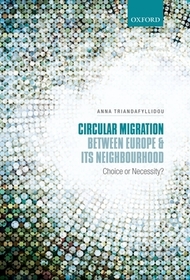
Circular Migration between Europe and its Neighbourhood
Choice or Necessity?
- Publisher's listprice GBP 127.50
-
60 913 Ft (58 012 Ft + 5% VAT)
The price is estimated because at the time of ordering we do not know what conversion rates will apply to HUF / product currency when the book arrives. In case HUF is weaker, the price increases slightly, in case HUF is stronger, the price goes lower slightly.
- Discount 10% (cc. 6 091 Ft off)
- Discounted price 54 821 Ft (52 211 Ft + 5% VAT)
Subcribe now and take benefit of a favourable price.
Subscribe
60 913 Ft

Availability
printed on demand
Why don't you give exact delivery time?
Delivery time is estimated on our previous experiences. We give estimations only, because we order from outside Hungary, and the delivery time mainly depends on how quickly the publisher supplies the book. Faster or slower deliveries both happen, but we do our best to supply as quickly as possible.
Product details:
- Publisher OUP Oxford
- Date of Publication 27 June 2013
- ISBN 9780199674510
- Binding Hardback
- No. of pages254 pages
- Size 240x184x24 mm
- Weight 536 g
- Language English 0
Categories
Short description:
The book offers comparative and in depth analysis of circular migration by empirical analysis of seven pairs of countries.
MoreLong description:
The term 'circular migration' has become a buzzword among European and international policy and academic circles in recent years. Many national and EU policy makers have heralded the idea of 'circular' migration with great enthusiasm as the solution to many of 'our' migration 'problems', supposedly addressing at once labour market shortages (by providing quickly and flexibly labour force on demand) and the migrant integration challenges (since circular migrants are not there to stay and hence will create very limited if any integration challenges).
This book studies the realities of circular migration on the ground by empirical analysis of seven pairs of countries: Greece-Albania, Italy-Albania; Italy-Morocco, Spain-Morocco; and Poland-Ukraine, Hungary-Ukraine, Italy-Ukraine. The book provides for a comparative and in depth analysis of circular migration between EU member states and countries in the EU's neighbourhood. It discusses critically the idea that circular migration is a triple-win situation (for migrants, states of origin, and destination countries) and looks at how relevant policies, migration statuses, labour markets, and other factors influence migrants' circulation. It poses and responds to the question whether circularity is a choice that brings higher economic and social or cultural gains than classical migration, or a necessity, a creative but not desirable strategy that migrants adopt in the absence of other options.
This book is noteworthy not only because of the abundance of research and information it contains but also because it emphasises the need for a stronger relationship between research and policy-making.
Table of Contents:
Circular Migration: Introductory Remarks
The Drive for Securitised Temporariness
Flexible circularities: Integration, return and socio-economic instability within Albanian migration to Italy
Albanian Circular Migration in Greece: Beyond the State?
Circular Economic Migration between Italy and Morocco
Circularity in a Restrictive Framework: Mobility between Morocco and Spain
Circular Migration between Hungary and Ukraine: Historical legacies, the economic crisis and the multi-directionality of 'circular' migration
Circular Migration Patterns between Ukraine and Poland
A Transnational Double Presence: Circular Migration between Ukraine and Italy
Circular Migration at the Periphery of Europe: Choice, Opportunity or Necessity?

