

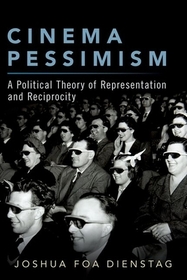
Cinema Pessimism
A Political Theory of Representation and Reciprocity
- Publisher's listprice GBP 31.49
-
14 217 Ft (13 540 Ft + 5% VAT)
The price is estimated because at the time of ordering we do not know what conversion rates will apply to HUF / product currency when the book arrives. In case HUF is weaker, the price increases slightly, in case HUF is stronger, the price goes lower slightly.
- Discount 10% (cc. 1 422 Ft off)
- Discounted price 12 795 Ft (12 186 Ft + 5% VAT)
Subcribe now and take benefit of a favourable price.
Subscribe
14 217 Ft

Availability
Only to order.
Why don't you give exact delivery time?
Delivery time is estimated on our previous experiences. We give estimations only, because we order from outside Hungary, and the delivery time mainly depends on how quickly the publisher supplies the book. Faster or slower deliveries both happen, but we do our best to supply as quickly as possible.
Product details:
- Publisher OUP USA
- Date of Publication 7 January 2020
- ISBN 9780190067724
- Binding Paperback
- No. of pages192 pages
- Size 137x206x10 mm
- Weight 249 g
- Language English 0
Categories
Short description:
Cinema Pessimism explores the challenges of representative democracy through film. Film allows us to see the problems of democracy from a unique perspective, illuminating dangers that are not always visible to us either from day-to-day experience or the classics of democratic theory. Joshua Foa Dienstag argues that there are threats lurking in our political systems that we fail to perceive due to the many pleasures that representation (both political and filmic) provides. Ultimately, Dienstag seeks to defend a kind of pessimistic politics that might produce a better sort of democratic representation than what we have today.
MoreLong description:
Aesthetic and political representation are often treated separately, but this book argues that film offers a unique perspective through which to understand the dangers to equality and freedom that lurk in representative politics. The potential problems of representative democracy have long been debated: does it cultivate apathy and discourage citizen participation? What does it mean to be faithfully or well represented in a democracy? And how can appropriate, meaningful representation be achieved? Here, these questions are addressed from a new perspective.
Representation, Joshua Foa Dienstag argues, can create the illusion of freedom and reciprocity in place of the real thing, and in both cinema and politics, what gives us pleasure is not the same as what secures or supports our existence as free and equal citizens. As this book shows, there are political dangers not visible within the current debates around democratic representation, dangers we can better understand and help to minimize by considering the way that human beings interact, emotionally, with their filmic representations.
Dienstag looks at a series of films that directly confront issues of representation (Her, Blade Runner, The Man Who Shot Liberty Valance, Melancholia, and the Up documentary series) to diagnose these hazards and consider how best to respond to them. Each chapter looks at a specific film as emblematic of a different conception or problem of representation often ignored by mainstream political debates (such as reciprocity, happiness, boundaries, evil) to show that the relationship between representation and freedom is fraught with tension. This book continues Dienstag's earlier groundbreaking work on philosophical pessimism, understood not as something despairing, but as a rejection of the idea that these necessary tensions can be cured. Ultimately, Dienstag seeks to defend a kind of pessimistic politics that might produce a better sort of democratic representation than what we have today.
In Cinema Pessimism, Dienstag challenges what he sees as the tendency of contemporary political and film theory to equate representation and freedom. He holds that while visual culture and contemporary politics have stretched the limits of visibility, representation does not automatically enhance human autonomy.
Table of Contents:
Introduction: Experiments in the Representative Condition.
1. Citizenship in an Age of Representation: her and us
2. Blade Runner's Humanism
3. The Legitimacy of Representation: The Man Who Shot Liberty Valance
4. Representing Evil: Von Trier's Werewolves
5. The UP Series and the Future of Representation
6. Conclusion: Cinema Pessimism
Notes
Bibliography
Index

