

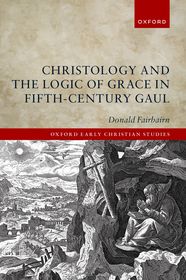
Christology and the Logic of Grace in Fifth-Century Gaul
Series: Oxford Early Christian Studies;
- Publisher's listprice GBP 84.00
-
37 926 Ft (36 120 Ft + 5% VAT)
The price is estimated because at the time of ordering we do not know what conversion rates will apply to HUF / product currency when the book arrives. In case HUF is weaker, the price increases slightly, in case HUF is stronger, the price goes lower slightly.
- Discount 20% (cc. 7 585 Ft off)
- Discounted price 30 341 Ft (28 896 Ft + 5% VAT)
- Discount is valid until: 30 June 2026
Subcribe now and take benefit of a favourable price.
Subscribe
37 926 Ft

Availability
Estimated delivery time: In stock at the publisher, but not at Prospero's office. Delivery time approx. 3-5 weeks.
Not in stock at Prospero.
Why don't you give exact delivery time?
Delivery time is estimated on our previous experiences. We give estimations only, because we order from outside Hungary, and the delivery time mainly depends on how quickly the publisher supplies the book. Faster or slower deliveries both happen, but we do our best to supply as quickly as possible.
Product details:
- Publisher OUP Oxford
- Date of Publication 19 December 2024
- ISBN 9780198936190
- Binding Hardback
- No. of pages240 pages
- Size 240x162x20 mm
- Weight 502 g
- Language English 555
Categories
Short description:
Explores the connection between Christology and grace in the thought of the fifth-century Gallic writers such as John Cassian, Vincent of Lérins, Prosper of Aquitaine, and Faustus of Riez.
MoreLong description:
The monastic writers in fifth-century southern Gaul have long been branded as 'Semi-Pelagians' because of their opposition to Augustine's teaching on predestination and grace. But an overlooked aspect of the grace-related discussions is the role that Christology plays in the articulation of grace, and in fact, the so-called 'Semi-Pelagians' all wrote on Christology in opposition to Nestorianism, as well as writing on grace. Their thinking was sparked at least as much by their opposition to Nestorius as it was by their disagreements with Augustine.
This book examines the relation between Christology and grace in the later writings of Augustine, in Leporius both before and after his correction, and in the Gallic writers John Cassian, Vincent of Lérins, Prosper of Aquitaine, and Faustus of Riez. It argues that the Gallic writers hold to a Christology very similar to that of Augustine, a Christology of divine descent in which the incarnate Word is the subject of the human actions and experiences of Christ. Furthermore, the book argues that Augustine and the Gallic writers all affirm the priority of divine grace in salvation, but they differ in the way they establish that priority.
Augustine and the Gallic writers reason between Christology and grace with a different logical sequence. Augustine starts with the incapacity of fallen humanity to save itself, then reasons to the predestination of the elect, and then understands the incarnation of the Word in terms of the particular effects on the elect. Predestination thus dominates his understanding of grace and soteriology. In contrast, the Gallic writers (including the later Prosper after he began to move away from Augustine) reason from human incapacity to the incarnation, thus understanding the descent of the Word as holding general effects for all humanity. Only then do they reason to the particular aspects of grace in Christian life. Predestination is thus less central to their thought and can be understood in a different way than in Augustine's later works.
Fairbairn's book upends many myths and demonstrates a unity ofpurpose between Augustine and monastics in south Gaul against theperceived links between 'Nestorianism' and Pelagianism. He is to be commended for his rich research and attention to detail.
Table of Contents:
Introduction
Setting the Stage: Christology and Grace in Augustine's Later Writings
Leporius: A Crypto-'Pelagian', Proto-'Nestorian'?
John Cassian: 'Nestorius', Grace, and the Monastic Life
Vincent of Lérins: 'Nestorius', Christian Orthodoxy, and Grace
Prosper of Aquitaine: Grace, 'Nestorianism', and God's Salvific Will
Faustus of Riez: 'Nestorianism' and Prima Gratia
Conclusion

