

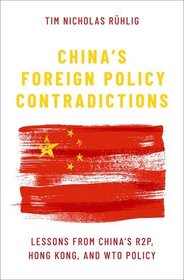
China's Foreign Policy Contradictions
Lessons from China's R2P, Hong Kong, and WTO Policy
- Publisher's listprice GBP 78.00
-
35 217 Ft (33 540 Ft + 5% VAT)
The price is estimated because at the time of ordering we do not know what conversion rates will apply to HUF / product currency when the book arrives. In case HUF is weaker, the price increases slightly, in case HUF is stronger, the price goes lower slightly.
- Discount 10% (cc. 3 522 Ft off)
- Discounted price 31 695 Ft (30 186 Ft + 5% VAT)
Subcribe now and take benefit of a favourable price.
Subscribe
35 217 Ft

Availability
Estimated delivery time: In stock at the publisher, but not at Prospero's office. Delivery time approx. 3-5 weeks.
Not in stock at Prospero.
Why don't you give exact delivery time?
Delivery time is estimated on our previous experiences. We give estimations only, because we order from outside Hungary, and the delivery time mainly depends on how quickly the publisher supplies the book. Faster or slower deliveries both happen, but we do our best to supply as quickly as possible.
Product details:
- Publisher OUP USA
- Date of Publication 29 April 2022
- ISBN 9780197573303
- Binding Hardback
- No. of pages278 pages
- Size 165x251x27 mm
- Weight 544 g
- Language English 191
Categories
Short description:
China's rise to great power status is indisputable but can it shape the future international order? This question remains widely debated because China's foreign policy is contradictory. Contrary to conventional wisdom, this book shows that China does not act from a position of strength, but that foreign policy contradictions are the result of the domestic vulnerabilities of the ruling Chinese Communist Party. Providing exceptional insights into the considerations behind the opaque institutional structures of Chinese foreign policymaking and decision making, it shows that China will not provide a "model" for a new international system, but could undermine the existing order.
MoreLong description:
Throughout the post-Mao reform era, China has championed the principle of sovereign state control, which holds that states should not intervene in the affairs of other states. Yet as Tim Nicholas Rühlig argues in China's Foreign Policy Contradictions, in recent years they have not actually acted this way. Chinese foreign policy actions fail to match up with official rhetoric, and these inconsistencies—in combination with China's growing power-will have dramatic effects on the future shape of international order.
To explain these contradictions, Rühlig draws from a rich battery of in-depth interviews with party-state officials to explain the foreign policy dynamics and processes of the normally opaque Chinese party-state. He demonstrates how different sources of the Chinese Communist Party's domestic legitimacy compete within the complex and highly fragmented Chinese party-state, resulting in contradictory foreign policies. He focuses on three issue areas: international human rights law and "responsibility to protect" (R2P); China's role in World Trade Organization (WTO) policymaking; and China's evolving relationship with Hong Kong. In each area, different factions within the party-state wrestle for control, with domestic legitimacy of the party always being the overriding goal. This incessant competition within the state's institutions often makes the PRC's foreign policy contradictory, undermining its ability to project and promote a "China Model" as an alternative to the existing international order (and more specifically as a champion of nonintervention). Instead, it often pursues narrowly nationalistic interests.
By elucidating how foreign policymakers strategize and react within the context of a massive and complex bureaucratic system that is constantly under pressure from many sides, Rühlig shows not only why China's foreign policy is so inconsistent, but why it is likely to contribute to a more particularistic, plural, and fragmented international order in the years to come. This book represents a significant advance in our understanding of the foreign policymaking process in authoritarian regimes.
By elaborating on the diversity of actors and the multiple layers of Chinese politics, he offers a sound explanation for the perceived contradictions in China's engagement in global affairs and delineates ways to deal with an internally fragmented China.
Table of Contents:
I. Introduction
I.1 Why bother about Chinese foreign policy contradictions?
I.2 Rule monopolist vs. rule manager: China and the transformation of the state
I.3 Towards an anthropology of China's foreign policymaking
I.4 The four main contributions of this book
I.5 Outline of the book
II. Unpacking the Chinese party-state
II. 1 State image and state transformation in "New China"
II.1.1 China's party-state as a rule monopolist
II.1.2 China's party-state as a rule manager
II.2 The contested approach to the role of the state and China's contradictory foreign policy
III. Chinese approaches to international security: the Responsibility to Protect
III.1 China's contradictory R2P policy
III.1.1 China's approach to the R2P in Libya
III.1.2 China's approach to the R2P in Syria
III. 2 Understanding China's contradictory R2P policy
III.2.1 The implications of trade-offs in the CCP's legitimization for China's R2P policy
III.2.2 China's R2P policy: decision-making and institutions
III.3 Implications of China's contradictory R2P policy for the international order
III.4 Summary of findings
IV. Chinese approaches to rule: One Country, Two Systems in Hong Kong
IV.1 China's contradictory Hong Kong policy
IV.1.1 China's approach to national security under article 23 of the Basic Law
IV.1.2 China's approach to electoral reform under article 45 of the Basic Law
IV.2 Understanding China's contradictory Hong Kong policy
IV.2.1 The implications of trade-offs in the CCP's legitimization for China's Hong Kong policy
IV.2.2 The implications of the party-state's structure for China's Hong Kong policy
IV.3 Implications of China's contradictory Hong Kong policy for the international order
IV.4 Summary of findings
V. Chinese approaches to welfare: the implementation of WTO law
V.1 China's contradictory WTO policy
V.1.1 China's approach to the DSB
V.1.2 China's approach to WTO law in the banking sector
V.2 Understanding China's contradictory WTO policy
V.2.1 The implications of trade-offs in the CCP's legitimization for China's WTO policy
V.2.2 The implications of the party-state's structure for China's WTO policy
V.3 Implications of China's contradictory WTO policy for the international order
V.4 Summary of findings
VI. Conclusions
VI.1 China's foreign policy contradictions and the future international order
VI.2 Contributions to existing research
VI.3 Implications for policymakers and practitioners
References
Notes

