

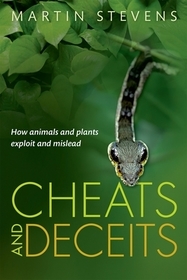
Cheats and Deceits
How Animals and Plants Exploit and Mislead
- Publisher's listprice GBP 27.49
-
13 133 Ft (12 507 Ft + 5% VAT)
The price is estimated because at the time of ordering we do not know what conversion rates will apply to HUF / product currency when the book arrives. In case HUF is weaker, the price increases slightly, in case HUF is stronger, the price goes lower slightly.
- Discount 10% (cc. 1 313 Ft off)
- Discounted price 11 819 Ft (11 256 Ft + 5% VAT)
Subcribe now and take benefit of a favourable price.
Subscribe
13 133 Ft

Availability
printed on demand
Why don't you give exact delivery time?
Delivery time is estimated on our previous experiences. We give estimations only, because we order from outside Hungary, and the delivery time mainly depends on how quickly the publisher supplies the book. Faster or slower deliveries both happen, but we do our best to supply as quickly as possible.
Product details:
- Publisher OUP Oxford
- Date of Publication 4 February 2016
- ISBN 9780198707899
- Binding Hardback
- No. of pages322 pages
- Size 240x167x20 mm
- Weight 680 g
- Language English
- Illustrations 69 colour figures 0
Categories
Short description:
The natural world is not a harmonious place. In the fight to survive and reproduce, any advantage in getting a mate, finding food, or avoiding predators pays dividends. Martin Stevens explores how animals and plants trick, cheat, and deceive each other to their own advantage in their bid for survival.
MoreLong description:
In nature, trickery and deception are widespread. Animals and plants mimic other objects or species in the environment for protection, trick other species into rearing their young, lure prey to their death, and deceive potential mates for reproduction. Cuckoos lay eggs carefully matched to their host's own clutch. Harmless butterflies mimic the wing patterning of a poisonous butterfly to avoid being eaten. The deep-sea angler fish hangs a glowing, fleshy lure in front of its mouth to draw the attention of potential prey, while some male fish alter their appearance to look like females in order to sneak past rivals in mating. Some orchids develop the smell of female insects in order to attract pollinators, while carnivorous plants lure insects to their death with colourful displays.
In this book, Martin Stevens describes the remarkable range of such adaptations in nature, and considers how they have evolved, and become increasingly perfected as part of an arms race between predator and prey or host and parasite. He explores the work of naturalists and biologists from Alfred Russel Wallace to current research, showing how scientists find ways of testing the impact of particular behaviours and colourings on the animals it is meant to fool, as opposed to our human perceptions. Drawing on a wide range of examples, Stevens considers what deception tells us about the process of evolution and adaptation.
Relish the wild world's duplicity: Cheats and Deceits by Martin Stevens
Table of Contents:
The Basis of Deception in Nature
Thieves and Liars
Lured into an Early Grave
Disruption and Dazzle
A Spider in Ant's Clothing
Bluff and Surprise
An Imposter in the Nest
Spreading Genes and Sexual Mimicry
The Future of Deception
Notes & References
Further Reading
Index

