

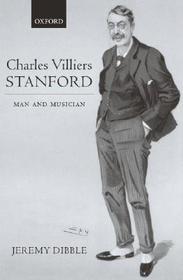
Charles Villiers Stanford
Man and Musician
- Publisher's listprice GBP 172.50
-
77 883 Ft (74 175 Ft + 5% VAT)
The price is estimated because at the time of ordering we do not know what conversion rates will apply to HUF / product currency when the book arrives. In case HUF is weaker, the price increases slightly, in case HUF is stronger, the price goes lower slightly.
- Discount 10% (cc. 7 788 Ft off)
- Discounted price 70 095 Ft (66 758 Ft + 5% VAT)
Subcribe now and take benefit of a favourable price.
Subscribe
77 883 Ft

Availability
Out of print
Why don't you give exact delivery time?
Delivery time is estimated on our previous experiences. We give estimations only, because we order from outside Hungary, and the delivery time mainly depends on how quickly the publisher supplies the book. Faster or slower deliveries both happen, but we do our best to supply as quickly as possible.
Product details:
- Publisher OUP Oxford
- Date of Publication 7 November 2002
- ISBN 9780198163831
- Binding Hardback
- No. of pages454 pages
- Size 241x164x35 mm
- Weight 1004 g
- Language English
- Illustrations 16pp halftone plates and numerous music examples 0
Categories
Short description:
Jeremy Dibble presents the first authoritative, comprehensive study of the life and works of Charles Villiers Stanford (1852-1924), one of the most gifted and influential composers. Dibble reveals how, although perhaps best known for his church music, Stanford was also an eminent symphonist, songwriter, and author of many fine choral works. Cosmopolitan, ambitious, and pragmatic, he was untiring in his efforts to advance the cause of British music during its
renaissance at the end of the nineteenth century, promoting the music of his contemporaries, and the many pupils he taught at Cambridge and the Royal College of Music, including Vaughan Williams, Ireland, Howells, Bliss, Holst, and Gurney.
Long description:
Charles Villiers Stanford is invariably remembered as the teacher of many of Britain's first generation of twentieth-century composers, and as the author of many much-loved works for the Anglican liturgy. He was, however, a composers fo great diversity and vision. A symphonist, songwriter, and composer of the Requiem, the Stabat Mater, the memorable, Songs of the Sea, Songs of the Fleet, and the haunting setting of Mary Coleridge's
'The Blue Bird', he aspired most of all to be a successful operatic composer though in this province of composition his fortunes were plagued by disappointment and neglect. More cosmopolitan in outlook than his contemporary, Parry, he was driven by ambition and a sense of mission to advance the cause of British music not only as a
composer but as a university professor, practical musician, and public proselyte. Pre-eminent in the 1880s and 90s, he was eclipsed by Elgar during the Edwardian years. Resentment, fuelled by the hurt of Elgar's inaugural Birmingham lecture, served to accentuate an innate irascibility and truculence which blighted his friendships and professional life. Nevertheless, Stanford must be recognised as one of the most natural musical talents Britain has ever produced, which is evident in the
extraordinary breadth of his creative output, which, on closer acquaintance, reveals a fecund originality shaped by classical equipoise and fertile melodic gift.
Dibble's writing has genteel passion, and a craftmanship apt for a subject who placed such value on traditional compositional craft.
Table of Contents:
List of Plates
Preface and Acknowledgements
Abbreviations
Dublin, Family, and Friends
Childhood: Dublin in the 1850s and 60s
Cambridge and Wanderjahren (Leipzig and Berlin) (1870-77)
A Promising Future: The Cambridge University Musical Society, Opera, and a Revolution in church Music (1877-1882)
The Royal College of Music (1883-1887)
Professorship at Cambridge: National and International Recognition (1888-92)
Removal from Cambridge: The Focus of London (1892-5)
Shamus O'Brien, the Requiem, and the Leeds Philharmonic Society (1896-1900)
The Leeds Festival, Knightgood, and the New Generation (1901-9)
Resignation from Leeds, Patriotism, and Political Isolation (1910-14)
The War (1914-1918)
The Last Years (1918-1924)
Appendix: List of Works
Bibliography
Index of Works
Index

