

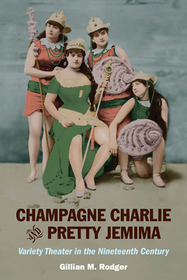
Champagne Charlie and Pretty Jemima
Variety Theater in the Nineteenth Century
Series: Music in American Life; 561;
- Publisher's listprice GBP 22.99
-
10 983 Ft (10 460 Ft + 5% VAT)
The price is estimated because at the time of ordering we do not know what conversion rates will apply to HUF / product currency when the book arrives. In case HUF is weaker, the price increases slightly, in case HUF is stronger, the price goes lower slightly.
- Discount 10% (cc. 1 098 Ft off)
- Discounted price 9 885 Ft (9 414 Ft + 5% VAT)
Subcribe now and take benefit of a favourable price.
Subscribe
10 983 Ft

Availability
Estimated delivery time: In stock at the publisher, but not at Prospero's office. Delivery time approx. 3-5 weeks.
Not in stock at Prospero.
Why don't you give exact delivery time?
Delivery time is estimated on our previous experiences. We give estimations only, because we order from outside Hungary, and the delivery time mainly depends on how quickly the publisher supplies the book. Faster or slower deliveries both happen, but we do our best to supply as quickly as possible.
Product details:
- Edition number 1st Edition
- Publisher University of Illinois Press
- Date of Publication 17 June 2010
- Number of Volumes Paperback
- ISBN 9780252077340
- Binding Paperback
- See also 9780252035395
- No. of pages296 pages
- Size 235x156x20 mm
- Weight 513 g
- Language English
- Illustrations 23 black & white photographs 0
Categories
Long description:
In this rich, imaginative survey of variety musical theater, Gillian M. Rodger masterfully chronicles the social history and class dynamics of the robust, nineteenth-century American theatrical phenomenon that gave way to twentieth-century entertainment forms such as vaudeville and comedy on radio and television. Fresh, bawdy, and unabashedly aimed at the working class, variety honed in on its audience's fascinations, emerging in the 1840s as a vehicle to accentuate class divisions and stoke curiosity about gender and sexuality. Cross-dressing acts were a regular feature of these entertainments, and Rodger profiles key male impersonators Annie Hindle and Ella Wesner while examining how both gender and sexuality gave shape to variety. By the last two decades of the nineteenth century, variety theater developed into a platform for ideas about race and whiteness.
As some in the working class moved up into the middling classes, they took their affinity for variety with them, transforming and broadening middle-class values. Champagne Charlie and Pretty Jemima places the saloon keepers, managers, male impersonators, minstrels, acrobats, singers, and dancers of the variety era within economic and social contexts by examining the business models of variety shows and their primarily white, working-class urban audiences. Rodger traces the transformation of variety from sexualized entertainment to more family-friendly fare, a domestication that mirrored efforts to regulate the industry, as well as the adoption of aspects of middle-class culture and values by the shows' performers, managers, and consumers.

