

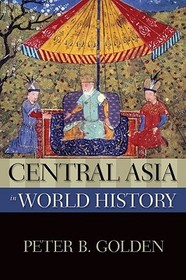
Central Asia in World History
Series: New Oxford World History;
- Publisher's listprice GBP 29.49
-
14 088 Ft (13 417 Ft + 5% VAT)
The price is estimated because at the time of ordering we do not know what conversion rates will apply to HUF / product currency when the book arrives. In case HUF is weaker, the price increases slightly, in case HUF is stronger, the price goes lower slightly.
- Discount 10% (cc. 1 409 Ft off)
- Discounted price 12 679 Ft (12 075 Ft + 5% VAT)
Subcribe now and take benefit of a favourable price.
Subscribe
14 088 Ft

Availability
printed on demand
Why don't you give exact delivery time?
Delivery time is estimated on our previous experiences. We give estimations only, because we order from outside Hungary, and the delivery time mainly depends on how quickly the publisher supplies the book. Faster or slower deliveries both happen, but we do our best to supply as quickly as possible.
Product details:
- Publisher OUP USA
- Date of Publication 24 February 2011
- ISBN 9780195338195
- Binding Paperback
- No. of pages192 pages
- Size 231x155x15 mm
- Weight 318 g
- Language English
- Illustrations 18 halftones, 6 maps 0
Categories
Short description:
This compact book traces the history of the nomadic steppe tribes and sedentary inhabitants of the oasis city-states of Central Asia from pre-history to the present. Golden covers themes of trade, religion, empire, technology, and language as he introduces readers to the people who have inhabitedge this region.
MoreLong description:
A vast region stretching roughly from the Volga River to Manchuria and the northern Chinese borderlands, Central Asia has been called the "pivot of history," a land where nomadic invaders and Silk Road traders changed the destinies of states that ringed its borders, including pre-modern Europe, the Middle East, and China. In Central Asia in World History, Peter B. Golden provides an engaging account of this important region, ranging from prehistory to the present, and focusing largely on the unique melting pot of cultures that this region has produced. Golden describes the traders who braved the heat and cold along caravan routes to link East Asia and Europe; the Mongol Empire of Genghis Khan and his successors, the largest contiguous land empire in history; the invention of gunpowder, which allowed the great sedentary empires to overcome the horse-based nomads; the power struggles of Russia and China, and later Russia and Britain, for control of the area. Finally, he discusses the region today, a key area that neighbors such geopolitical hot spots as Iran, Afghanistan, Pakistan, and China.
This concise but comprehensive textbook outlines the transformation of Central Asia from prehistory to the collapse of the USSR. ... The scope is ambitious ... the book is chronologically, spatially, and thematically wide-ranging without sacrificing the level of detail in the narrative.
Table of Contents:
Editors' Preface
Introduction: A Layering of Peoples
The Rise of Nomadism and the Oasis City-States
The Early Nomads: "Warfare is Their Business"
Heavenly Qaghans: The Türks and Their Successors
The Cities of the Silk Road and the Coming of Islam.
Crescent over the Steppe: Islam and the Turkic Peoples
The Mongol Whirlwind
The Later Chinggisids, Temür and the Timurid Renaissance
The Age of Gunpowder and the Crush of Empires
The Problems of Modernity
Pronunciation Guide
Chronology
Notes
Further Reading
Websites
Acknowledgments
Index

