

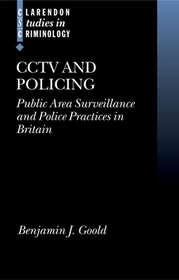
CCTV and Policing
Public Area Surveillance and Police Practices in Britain
Series: Clarendon Studies in Criminology;
- Publisher's listprice GBP 75.00
-
33 862 Ft (32 250 Ft + 5% VAT)
The price is estimated because at the time of ordering we do not know what conversion rates will apply to HUF / product currency when the book arrives. In case HUF is weaker, the price increases slightly, in case HUF is stronger, the price goes lower slightly.
- Discount 10% (cc. 3 386 Ft off)
- Discounted price 30 476 Ft (29 025 Ft + 5% VAT)
Subcribe now and take benefit of a favourable price.
Subscribe
33 862 Ft

Availability
printed on demand
Why don't you give exact delivery time?
Delivery time is estimated on our previous experiences. We give estimations only, because we order from outside Hungary, and the delivery time mainly depends on how quickly the publisher supplies the book. Faster or slower deliveries both happen, but we do our best to supply as quickly as possible.
Product details:
- Publisher OUP Oxford
- Date of Publication 19 February 2004
- ISBN 9780199265145
- Binding Hardback
- No. of pages260 pages
- Size 224x144x17 mm
- Weight 426 g
- Language English
- Illustrations numerous tables 0
Categories
Short description:
CCTV and Policing considers how the introduction of closed circuit television (CCTV) has affected policing practices in Britain. Based on original field research, the volume examines the various factors that have shaped police CCTV use, and challenges claims that the spread of public area CCTV is indicative of a movement towards increasingly authoritarian forms of policing.
MoreLong description:
CCTV and Policing is the first major published work to present a comprehensive assessment of the impact of CCTV on the police in Britain. Drawing extensively upon empirical research, the volume examines how the police in Britain first became involved in public area surveillance, and how they have since attempted to use CCTV technology to prevent, respond to, and investigate crime. In addition, the volume also provides a detailed analysis of the legality of CCTV surveillance in light of recent changes to the Data Protection Act and the incorporation of the European Convention on Human Rights. Challenging many existing accounts of the relationship between the police and new surveillance technologies, CCTV and Policing breaks new ground in policing and surveillance theory, and argues that it is time for a major reassessment of both our understanding of how the police respond to technological change, and of the role played by such technologies in our society.
CCTV and Policing is a rigorous piece of work that sheds fascinating light on a subject too little discussed, and it deserves to be read far outside the realm of academic criminology, especially by those concerned about civil liberties.
Table of Contents:
Under Surveillance
Research Methods
Playing 'Little Brother'
Going by the Codes
Working Together?
Choosing Targets
The Effect of CCTV on Policing
Conclusions

