

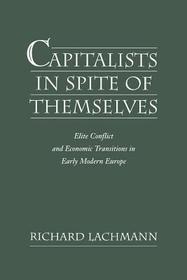
Capitalists in Spite of Themselves
Elite Conflict and Economic Transitions in Early Modern Europe
- Publisher's listprice GBP 68.00
-
30 702 Ft (29 240 Ft + 5% VAT)
The price is estimated because at the time of ordering we do not know what conversion rates will apply to HUF / product currency when the book arrives. In case HUF is weaker, the price increases slightly, in case HUF is stronger, the price goes lower slightly.
- Discount 15% (cc. 0 Ft off)
- Discounted price 26 097 Ft (24 854 Ft + 5% VAT)
- Discount is valid until: 5 August 2026
Subcribe now and take benefit of a favourable price.
Subscribe
30 702 Ft

Availability
printed on demand
Why don't you give exact delivery time?
Delivery time is estimated on our previous experiences. We give estimations only, because we order from outside Hungary, and the delivery time mainly depends on how quickly the publisher supplies the book. Faster or slower deliveries both happen, but we do our best to supply as quickly as possible.
Product details:
- Publisher OUP USA
- Date of Publication 1 November 2002
- ISBN 9780195159608
- Binding Paperback
- No. of pages336 pages
- Size 234x151x21 mm
- Weight 494 g
- Language English 0
Categories
Short description:
Here, Lachmann offers a new explanation for the origins of nation-states and capitalist markets in early modern Europe. Comparing regions and cities within and across England, France, Italy, Spain, and the Netherlands from the 12th through 18th centuries, he shows how conflict among feudal elites---landlords, clerics, kings, and officeholders---transformed the bases of their control over land and labor, forcing the winners of feudal conflicts to become capitalists in spite of themselves as they took defensive actions to protect their privileges from rivals in the aftermath of the Reformation.
MoreLong description:
Here, Richard Lachmann offers a new answer to an old question: Why did capitalism develop in some parts of early modern Europe but not in others? Finding neither a single cause nor an essentialist unfolding of a state or capitalist system, Lachmann describes the highly contingent development of various polities and economies. He identifies, in particular, conflict among feudal elites--landlords, clerics, kings, and officeholders--as the dynamic which perpetuated manorial economies in some places while propelling elites elsewhere to transform the basis of their control over land and labor.
Comparing regions and cities within and across England, France, Italy, Spain, and the Netherlands from the twelfth through eighteenth centuries, Lachmann breaks new ground by showing step by step how the new social relations and political institutions of early modern Europe developed. He demonstrates in detail how feudal elites were pushed toward capitalism as they sought to protect their privileges from rivals in the aftermath of the Reformation.
Capitalists in Spite of Themselves is a compelling narrative of how elites and other classes made and responded to political and religious revolutions while gradually creating the nation-states and capitalist markets which still constrain our behavior and order our world. It will prove invaluable for anyone wishing to understanding the economic and social history of early modern Europe.
"Richard Lachmann's Capitalists in Spite of Themselves is a strikingly original and analytically powerful study of the transition from feudalism to capitalism in Western Europe. It is not simply one more study that repackages familiar arguments in new rhetoric. It proposes a novel synthesis of ideas derived from Marxist class analysis and theories of elite conflict. He then deploys this reasoning in a diverse and compelling series of case studies of medieval and early modern Europe written in an engaging and accessible manner. This book should be read, studied, and debated by anyone interested in large-scale historical processes of social change." --Erik Olin Wright, University of Wisconsin, Madison
Table of Contents:
Something Happened
Feudal Dynamics
The Limits of Urban Capitalism
State Formation
A Dead End and a Detour: Spain and the Netherlands
Elite Defensiveness and the Transformation of Class Relations in Britain and France
Religions and Ideology
Conclusion
Notes
Bibliography

