

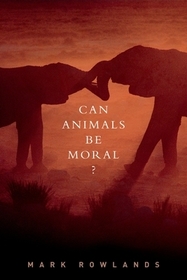
Can Animals Be Moral?
- Publisher's listprice GBP 46.99
-
22 449 Ft (21 380 Ft + 5% VAT)
The price is estimated because at the time of ordering we do not know what conversion rates will apply to HUF / product currency when the book arrives. In case HUF is weaker, the price increases slightly, in case HUF is stronger, the price goes lower slightly.
- Discount 10% (cc. 2 245 Ft off)
- Discounted price 20 204 Ft (19 242 Ft + 5% VAT)
Subcribe now and take benefit of a favourable price.
Subscribe
22 449 Ft

Availability
printed on demand
Why don't you give exact delivery time?
Delivery time is estimated on our previous experiences. We give estimations only, because we order from outside Hungary, and the delivery time mainly depends on how quickly the publisher supplies the book. Faster or slower deliveries both happen, but we do our best to supply as quickly as possible.
Product details:
- Publisher OUP USA
- Date of Publication 6 December 2012
- ISBN 9780199842001
- Binding Hardback
- No. of pages272 pages
- Size 211x140x25 mm
- Weight 386 g
- Language English 0
Categories
Short description:
Can animals act morally? Philosophical tradition answers 'no,' and has apparently convincing arguments on its side. Cognitive ethology supplies a growing body of empirical evidence that suggests these arguments are wrong. This groundbreaking book assimilates both philosophical and ethological frameworks into a unified whole and argues for a qualified 'yes.'
MoreLong description:
Can animals act for moral reasons? Philosophical tradition answers, almost univocally, "no." Recent work in cognitive ethology, however, points in the other direction. Philosophical tradition has apparently convincing arguments on its side. But cognitive ethology can point to a growing body of empirical evidence that suggests these arguments must be wrong. This groundbreaking book assimilates both philosophical and ethological frameworks into a unified whole. In part, ethologists have not understood the enormous logical obstacles facing the claim that animals can act morally. But, in part also, philosophers have been guilty of over-intellectualizing crucial concepts such as moral motivation and action. Building on the ethological evidence, this book engages in meticulous philosophical analysis and argument, and the resulting answer to the question is a qualified "yes." Animals can act morally in the sense they can act for moral reasons. Or, at least, they are no compelling logical obstacles to supposing that this is the case. This conclusion has important implications not just for our understanding of animals but also of the central concepts we employ in understanding the moral lives of humans, such as motivation, action, and agency.
Can Animals Be Moral? offers the most comprehensive analysis and evaluation to date of the traditional views underlying scepticism about the moral subjecthood of animals and it does an excellent job of clarifying the conceptual and argumentative landscape.
Table of Contents:
1. Can Animals be Moral?
2. Attributing Emotions to Animals
3. Moral Agents, Patients, and Subjects
4. The Reflection Condition: Aristotle and Kant
5. The Idiot
6. The Phenomenology of Moral Motivation
7. Moral Motivation and Meta-Cognition
8. Moral Reasons and Practice
9. Reconstructing Normativity and Agency
10. A Cognitive Ethologist from Mars

