

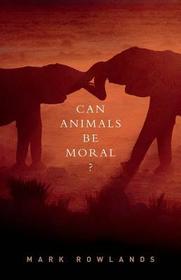
Can Animals Be Moral?
- Publisher's listprice GBP 37.99
-
17 152 Ft (16 335 Ft + 5% VAT)
The price is estimated because at the time of ordering we do not know what conversion rates will apply to HUF / product currency when the book arrives. In case HUF is weaker, the price increases slightly, in case HUF is stronger, the price goes lower slightly.
- Discount 10% (cc. 1 715 Ft off)
- Discounted price 15 437 Ft (14 702 Ft + 5% VAT)
Subcribe now and take benefit of a favourable price.
Subscribe
17 152 Ft

Availability
printed on demand
Why don't you give exact delivery time?
Delivery time is estimated on our previous experiences. We give estimations only, because we order from outside Hungary, and the delivery time mainly depends on how quickly the publisher supplies the book. Faster or slower deliveries both happen, but we do our best to supply as quickly as possible.
Product details:
- Publisher OUP USA
- Date of Publication 23 April 2015
- ISBN 9780190240301
- Binding Paperback
- No. of pages274 pages
- Size 213x137x20 mm
- Weight 318 g
- Language English 0
Categories
Short description:
Can animals act morally? Philosophical tradition answers "no," and has apparently convincing arguments on its side. Cognitive ethology supplies a growing body of empirical evidence that suggests these arguments are wrong.
MoreLong description:
From eye-witness accounts of elephants apparently mourning the death of family members to an experiment that showed that hungry rhesus monkeys would not take food if doing so gave another monkey an electric shock, there is much evidence of animals displaying what seem to be moral feelings. But despite such suggestive evidence, philosophers steadfastly deny that animals can act morally, and for reasons that virtually everyone has found convincing.
In Can Animals be Moral?, philosopher Mark Rowlands examines the reasoning of philosophers and scientists on this question--ranging from Aristotle and Kant to Hume and Darwin--and reveals that their arguments fall far short of compelling. The basic argument against moral behavior in animals is that humans have capabilities that animals lack. We can reflect on our motivations, formulate abstract principles that allow that allow us to judge right from wrong. For an actor to be moral, he or she must be able scrutinize their motivations and actions. No animal can do these things--no animal is moral. Rowland naturally agrees that humans possess a moral consciousness that no animal can rival, but he argues that it is not necessary for an individual to have the ability to reflect on his or her motives to be moral. Animals can't do all that we can do, but they can act on the basis of some moral reasons--basic moral reasons involving concern for others. And when they do this, they are doing just what we do when we act on the basis of these reasons: They are acting morally.
Can Animals Be Moral? offers the most comprehensive analysis and evaluation to date of the traditional views underlying scepticism about the moral subjecthood of animals and it does an excellent job of clarifying the conceptual and argumentative landscape.
Table of Contents:
1. Can Animals be Moral?
2. Attributing Emotions to Animals
3. Moral Agents, Patients, and Subjects
4. The Reflection Condition: Aristotle and Kant
5. The Idiot
6. The Phenomenology of Moral Motivation
7. Moral Motivation and Meta-Cognition
8. Moral Reasons and Practice
9. Reconstructing Normativity and Agency
10. A Cognitive Ethologist from Mars

