

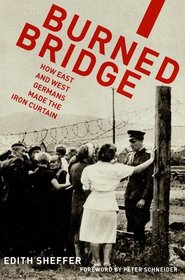
Burned Bridge
How East and West Germans Made the Iron Curtain
- Publisher's listprice GBP 35.99
-
16 249 Ft (15 475 Ft + 5% VAT)
The price is estimated because at the time of ordering we do not know what conversion rates will apply to HUF / product currency when the book arrives. In case HUF is weaker, the price increases slightly, in case HUF is stronger, the price goes lower slightly.
- Discount 10% (cc. 1 625 Ft off)
- Discounted price 14 624 Ft (13 928 Ft + 5% VAT)
Subcribe now and take benefit of a favourable price.
Subscribe
16 249 Ft

Availability
printed on demand
Why don't you give exact delivery time?
Delivery time is estimated on our previous experiences. We give estimations only, because we order from outside Hungary, and the delivery time mainly depends on how quickly the publisher supplies the book. Faster or slower deliveries both happen, but we do our best to supply as quickly as possible.
Product details:
- Publisher OUP USA
- Date of Publication 24 April 2014
- ISBN 9780199314614
- Binding Paperback
- No. of pages384 pages
- Size 231x155x25 mm
- Weight 499 g
- Language English
- Illustrations 34 halftones 0
Categories
Short description:
Examines "Burned Bridge," the intersection between two sister cities in East and West Germany, and reveals how the daily adjustments of anxious residents shaped the barrier that divided them.
MoreLong description:
The building of the Berlin Wall in 1961 shocked the world. Ever since, the image of this impenetrable barrier between East and West, imposed by communism, has been a central symbol of the Cold War.
Based on vast research in untapped archival, oral, and private sources, Burned Bridge reveals the hidden origins of the Iron Curtain, presenting it in a startling new light. Historian Edith Sheffer's unprecedented, in-depth account focuses on Burned Bridge-the intersection between two sister cities, Sonneberg and Neustadt bei Coburg, Germany's largest divided population outside Berlin. Sheffer demonstrates that as Soviet and American forces occupied each city after the Second World War, townspeople who historically had much in common quickly formed opposing interests and identities. The border walled off irreconcilable realities: the differences of freedom and captivity, rich and poor, peace and bloodshed, and past and present. Sheffer describes how smuggling, kidnapping, rape, and killing in the early postwar years led citizens to demand greater border control on both sides--long before East Germany fortified its 1,393 kilometer border with West Germany. It was in fact the American military that built the first barriers at Burned Bridge, which preceded East Germany's borderland crackdown by many years. Indeed, Sheffer shows that the physical border between East and West was not simply imposed by Cold War superpowers, but was in some part an improvised outgrowth of an anxious postwar society.
Ultimately, a wall of the mind shaped the wall on the ground. East and West Germans became part of, and helped perpetuate, the barriers that divided them. From the end of World War II through two decades of reunification, Sheffer traces divisions at Burned Bridge with sharp insight and compassion, presenting a stunning portrait of the Cold War on a human scale.
A vast amount of research.
Table of Contents:
Foreword by Peter Schneider
Introduction
Part One: Demarcation Line, 1945-1952
1. Foundations: Burned Bridge
2. Insecurity: Border Mayhem
3. Inequality: Economic Divides
4. Kickoff: Political Skirmishing
Part Two: "Living Wall," 1952-1961
5. Shock: Border Closure and Deportation
6. Shift: Everyday Boundaries
7. Surveillance: Individual Controls
Part Three: Iron Curtain, 1961-1989
8. Home: Life in the Prohibited Zone
9. Fault Line: Life in the Fortifications
10. Disconnect: East-West Relations
Epilogue: New Divides
Notes
Bibliography
Appendices

