

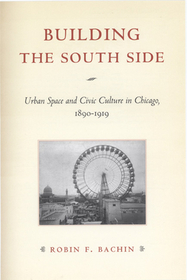
Building the South Side – Urban Space and Civic Culture in Chicago, 1890–1919
Getting Naked
Series: Historical Studies of Urban America;
- Publisher's listprice GBP 28.00
-
12 642 Ft (12 040 Ft + 5% VAT)
The price is estimated because at the time of ordering we do not know what conversion rates will apply to HUF / product currency when the book arrives. In case HUF is weaker, the price increases slightly, in case HUF is stronger, the price goes lower slightly.
- Discount 10% (cc. 1 264 Ft off)
- Discounted price 11 378 Ft (10 836 Ft + 5% VAT)
Subcribe now and take benefit of a favourable price.
Subscribe
12 642 Ft

Availability
Estimated delivery time: In stock at the publisher, but not at Prospero's office. Delivery time approx. 3-5 weeks.
Not in stock at Prospero.
Why don't you give exact delivery time?
Delivery time is estimated on our previous experiences. We give estimations only, because we order from outside Hungary, and the delivery time mainly depends on how quickly the publisher supplies the book. Faster or slower deliveries both happen, but we do our best to supply as quickly as possible.
Product details:
- Publisher University of Chicago Press
- Date of Publication 14 November 2008
- ISBN 9780226033945
- Binding Paperback
- No. of pages448 pages
- Size 230x159x24 mm
- Weight 630 g
- Language English 0
Categories
Short description:
Explores the struggle for influence that dominated the planning and development of Chicago's South Side during the Progressive Era. This work examines the University of Chicago, Chicago's public parks, and the Black Belt to consider how community leaders looked to the physical design of the city to shape its culture and promote civic interaction.
MoreLong description:
Explores the struggle for influence that dominated the planning and development of Chicago's South Side during the Progressive Era. This work examines the University of Chicago, Chicago's public parks, and the Black Belt to consider how community leaders looked to the physical design of the city to shape its culture and promote civic interaction.
More
