

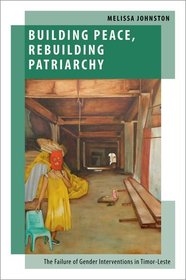
Building Peace, Rebuilding Patriarchy
The Failure of Gender Interventions in Timor-Leste
Series: OXF STUDIES GENDER INTL RELATIONS SERIES;
- Publisher's listprice GBP 57.00
-
25 735 Ft (24 510 Ft + 5% VAT)
The price is estimated because at the time of ordering we do not know what conversion rates will apply to HUF / product currency when the book arrives. In case HUF is weaker, the price increases slightly, in case HUF is stronger, the price goes lower slightly.
- Discount 10% (cc. 2 574 Ft off)
- Discounted price 23 162 Ft (22 059 Ft + 5% VAT)
Subcribe now and take benefit of a favourable price.
Subscribe
25 735 Ft

Availability
Estimated delivery time: In stock at the publisher, but not at Prospero's office. Delivery time approx. 3-5 weeks.
Not in stock at Prospero.
Why don't you give exact delivery time?
Delivery time is estimated on our previous experiences. We give estimations only, because we order from outside Hungary, and the delivery time mainly depends on how quickly the publisher supplies the book. Faster or slower deliveries both happen, but we do our best to supply as quickly as possible.
Product details:
- Publisher OUP USA
- Date of Publication 20 September 2023
- ISBN 9780197637999
- Binding Hardback
- No. of pages280 pages
- Size 163x237x22 mm
- Weight 526 g
- Language English 439
Categories
Short description:
Over the two decades since the adoption of United Nations Security Council Resolution 1325 on Women, Peace and Security, peacebuilding interventions around the globe have increasingly incorporated gender perspectives. Yet, the results have been uneven. In Building Peace, Rebuilding Patriarchy, Melissa Johnston explains why gender interventions often fail to help those who most need them, using the case of Timor-Leste, a country subjected to high levels of peacebuilding and gender interventions between 1999 and 2017. Looking at three types of gender interventions, Johnston makes the case that as peacebuilders seek to rebuild war-torn societies, understanding the intersection of social and gender order is more important than ever.
MoreLong description:
Over the two decades since the adoption of United Nations Security Council Resolution 1325 on Women, Peace and Security, peacebuilding interventions around the globe have increasingly incorporated gender perspectives. These initiatives have used both development programs and gender mainstreaming to advance women's empowerment, with the aim of making peacebuilding more effective as well as building more stable societies and efficient economies. This goal has been manifested in a wide range of programs and projects-or "gender interventions"--including economic empowerment measures, gender quotas, gender-responsive budgeting, and legal reforms. Yet, the results have been uneven, provoking a sizable debate among scholars and practitioners seeking to explain the shortcomings and improve the outcomes.
In Building Peace, Rebuilding Patriarchy, Melissa Johnston explains why gender interventions often fail to help those who most need them, using the case of Timor-Leste, a country subjected to high levels of peacebuilding and gender interventions between 1999 and 2017. Looking at three types of gender interventions--gender-responsive budgeting, the law against domestic violence, and microfinance initiatives--Johnston argues that these reforms have produced mixed results because they reinscribe entrenched class and gender hierarchies in their implementation.
Focusing on the connection between politics, economics, and gender, Johnston identifies the emergence of an elite class coalition, built on kinship and gender order in Timor-Leste as the root of the problem. Peacebuilders have made concessions to elites and violent men to keep the peace, a tendency amplified by "local turn" approaches to peacebuilding. As a result, deep inequalities remain and violence against women is endemic across the country. Compelling and insightful, Building Peace, Rebuilding Patriarchy makes the case that as peacebuilders seek to rebuild war-torn societies, understanding the intersection of social and gender order is more important than ever.
Melissa Johnston has penned what will surely be an instant classic in the fields of peacebuilding and post-conflict reconstruction. Through careful fieldwork, Johnston shows that international peacebuilders in Timor-Leste, in some cases knowingly and in other cases ignorantly, carefully rebuilt and strengthened the systems of patriarchy. As a result, not only women, but the nation of Timor-Leste itself, are in a worse situation because of the international community's peacebuilding intervention. The 'local turn' in peacebuilding is revealed by Johnston as a deal with the devil of women's subordination, with all the negative consequences thereof for the whole society. It's time to ask who really gets what from international peacebuilding efforts. Highly recommended.
Table of Contents:
Figures and tables
Associations and Organizations
Introduction
1. Critical Approaches to Peacebuilding and Gender
2. Class Formation, Slavery, and Militarization
3. Class, Gender, and the Distribution of State Resources
4. The Political Economy of Domestic Violence
5. Brideprice and the Exchange of Women
6. Microfinance Interventions
7. Gendered Circuits of Debt and Violence
Conclusion
Appendix
Glossary
References

