

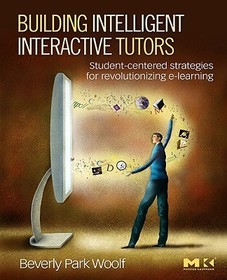
Building Intelligent Interactive Tutors
Student-centered Strategies for Revolutionizing E-learning
- Publisher's listprice EUR 74.95
-
29 275 Ft (27 881 Ft + 5% VAT)
The price is estimated because at the time of ordering we do not know what conversion rates will apply to HUF / product currency when the book arrives. In case HUF is weaker, the price increases slightly, in case HUF is stronger, the price goes lower slightly.
- Discount 10% (cc. 2 928 Ft off)
- Discounted price 26 348 Ft (25 093 Ft + 5% VAT)
Subcribe now and take benefit of a favourable price.
Subscribe
29 275 Ft

Availability
Out of print
Why don't you give exact delivery time?
Delivery time is estimated on our previous experiences. We give estimations only, because we order from outside Hungary, and the delivery time mainly depends on how quickly the publisher supplies the book. Faster or slower deliveries both happen, but we do our best to supply as quickly as possible.
Product details:
- Publisher Elsevier Science
- Date of Publication 7 October 2008
- ISBN 9780123735942
- Binding Paperback
- No. of pages480 pages
- Size 234x190 mm
- Weight 960 g
- Language English 0
Categories
Long description:
Building Intelligent Interactive Tutors discusses educational systems that assess a student's knowledge and are adaptive to a student's learning needs.
The impact of computers has not been generally felt in education due to lack of hardware, teacher training, and sophisticated software. and because current instructional software is neither truly responsive to student needs nor flexible enough to emulate teaching. Dr. Woolf taps into 20 years of research on intelligent tutors to bring designers and developers a broad range of issues and methods that produce the best intelligent learning environments possible, whether for classroom or life-long learning.
The book describes multidisciplinary approaches to using computers for teaching, reports on research, development, and real-world experiences, and discusses intelligent tutors, web-based learning systems, adaptive learning systems, intelligent agents and intelligent multimedia.
It is recommended for professionals, graduate students, and others in computer science and educational technology who are developing online tutoring systems to support e-learning, and who want to build intelligence into the system.
MoreTable of Contents:
PART I: INTRODUCTION TO ARTIFICIAL INTELLIGENCE AND EDUCATION
1. Introduction
2. Features
PART II: REPRESENTATION, REASONING AND ASSESSMENT
3. Student Knowledge
4. Tutoring Knowledge
5. Communication Knowledge
6. Evaluation of Tutors
PART III: TECHNOLOGIES AND ENVIRONMENTS
7. Machine Learning
8. Inquiry and Collaboration Tutors
9. Web-based Tutors
10. Future view

