

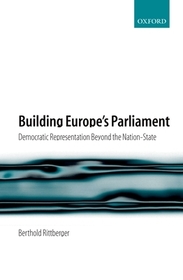
Building Europe's Parliament
Democratic Representation Beyond the Nation State
- Publisher's listprice GBP 127.50
-
57 566 Ft (54 825 Ft + 5% VAT)
The price is estimated because at the time of ordering we do not know what conversion rates will apply to HUF / product currency when the book arrives. In case HUF is weaker, the price increases slightly, in case HUF is stronger, the price goes lower slightly.
- Discount 10% (cc. 5 756 Ft off)
- Discounted price 51 810 Ft (49 343 Ft + 5% VAT)
Subcribe now and take benefit of a favourable price.
Subscribe
57 566 Ft

Availability
printed on demand
Why don't you give exact delivery time?
Delivery time is estimated on our previous experiences. We give estimations only, because we order from outside Hungary, and the delivery time mainly depends on how quickly the publisher supplies the book. Faster or slower deliveries both happen, but we do our best to supply as quickly as possible.
Product details:
- Publisher OUP Oxford
- Date of Publication 24 March 2005
- ISBN 9780199273423
- Binding Hardback
- No. of pages252 pages
- Size 242x165x20 mm
- Weight 529 g
- Language English
- Illustrations numerous tables 0
Categories
Short description:
Why have the national governments of EU member states successively endowed the European Parliament with supervisory, budgetary, and legislative powers? In this major contribution to the study of the European Parliament, Berthold Rittberger develops an original and compelling theory of delegation to representative institutions, and demonstrates just how and why the European Parliament has become so powerful.
MoreLong description:
Why have the national governments of EU member states successively endowed the European Parliament with supervisory, budgetary, and legislative powers over the past fifty years? Building Europe's Parliament sheds new light on this pivotal issue, and provides a major contribution to the study of the European Parliament.
Rittberger develops a theory of delegation to representative institutions in international politics which combines elements of democratic theory and different strands of institutionalist theory. To test the plausibility of his theory, Rittberger draws on extensive archival material and offers theory-guided, in-depth case studies of three landmark decisions in the history of the European Parliament: the creation of the Common Assembly of the ECSC in 1951 and the concomitant acquisition of supervisory powers vis-à-vis the quasi-executive High Authority; the delegation of budgetary powers following the signing of the Treaty of Luxembourg in 1970; and the delegation of legislative powers resulting from the adoption of the Single European Act signed in 1986. This is followed by the charting of more recent key developments, culminating in the adoption of the Constitutional Treaty in 2004.
The book provides a welcome addition to the literature on institutional design by reflecting on the conditions under which governments opt for the creation and empowerment of parliamentary institutions in international politics. It also makes a valuable contribution to the application of democratic theory to the study of the European Union by demonstrating that political elites shared the view that the new supranational polity which emerged from the debris of World War II suffered from 'democratic deficit' since its inception, thus disproving the claim that the lamented 'democratic deficit' is a recent phenomenon. Winner of the European Union Studies Association Prize for Best Dissertation 2002-2004
Rittberger has written a convincing and fascinating account of the birth and empowerment of the worlds only supranational legislature.
Table of Contents:
Introduction: Building Europe's Parliament
Part I: Theory
The Empowerment of the European Parliament: Lessons from the New Institutionalism and Democratic Theory
Parliamentary Institutions in International Polities: What are the Conditions?
Part II: The European Parliament's Power Trias
The Origins of the Common Assembly of the European Coal and Steel Community
Budgetary Powers and the Treaty of Luxembourg
Legislative Powers and the Single European Act
From Maastricht to the Constitutional Treaty: The Return of National Parliaments?
Conclusion: No Integration without Representation?
Bibliography

