

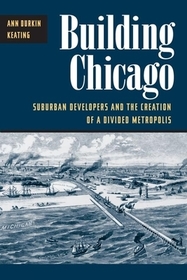
Building Chicago – Suburban Developers and the Creation of a Divided Metropolis
Suburban Developers and the Creation of a Divided Metropolis
- Publisher's listprice GBP 13.99
-
6 683 Ft (6 365 Ft + 5% VAT)
The price is estimated because at the time of ordering we do not know what conversion rates will apply to HUF / product currency when the book arrives. In case HUF is weaker, the price increases slightly, in case HUF is stronger, the price goes lower slightly.
- Discount 10% (cc. 668 Ft off)
- Discounted price 6 015 Ft (5 729 Ft + 5% VAT)
Discounted price for customers subscribed to our weekly newsletter.
Subcribe now and take benefit of a favourable price.
Subscribe
Subcribe now and take benefit of a favourable price.
Subscribe
6 683 Ft

Availability
Temporarily out of stock.
Why don't you give exact delivery time?
Delivery time is estimated on our previous experiences. We give estimations only, because we order from outside Hungary, and the delivery time mainly depends on how quickly the publisher supplies the book. Faster or slower deliveries both happen, but we do our best to supply as quickly as possible.
Product details:
- Publisher MO – University of Illinois Press
- Date of Publication 29 March 2002
- Number of Volumes Paperback
- ISBN 9780252070556
- Binding Paperback
- No. of pages264 pages
- Size 227x152x28 mm
- Weight 604 g
- Language English 0
Categories
Long description:
The modern suburbanite lives among manicured lawns, shopping centers, and public schools with private school reputations. Socially and economically dependent on the city, but autonomously governed, suburban life ostensibly offers the best of both worlds. In Building Chicago, Ann Durkin Keating offers a fascinating account of the birth and growth of Chicago's suburbs, the governments that developed to service them, and the ideas that guided early urban development.
Chicago's rapid growth in the mid-nineteenth century was countered by cholera outbreaks, swampy roads, and poor living conditions. With the advent of rail transportation, city workers began to flock to burgeoning settlements outlying the city center. Various types of suburbs emerged, some as ethnic enclaves, others based on social and economic class. As they expanded, so did the need for schools, fire and police departments, water and sewer systems, and consequently, government. In the nineteenth century, nascent Cook County suburbs had just two options for government: the urban charter or the rural township.
Beginning in the 1860s, the Illinois state legislature allowed rural townships, as well as distinct settlements beyond Chicago, to add to their local powers through incorporation. Hybrids of rural and urban forms resulted in the first suburban governments. The incorporated townships, which ringed Chicago by the early 1880s, had a diverse range of constituents and proved unsuccessful as a suburban form. They were largely annexed to Chicago in 1889. The incorporated village emerged as the basic form of suburban government that would flourish in the twentieth century.
With precision and striking detail, Keating documents the progress and failure of suburbs under their chosen governments and argues that Chicago, as a case study, is representative of the suburban landscapes of major metropolitan areas across the country. In its first paperback edition, Building Chicago includes a comprehensive photographic essay by the author.
More
Chicago's rapid growth in the mid-nineteenth century was countered by cholera outbreaks, swampy roads, and poor living conditions. With the advent of rail transportation, city workers began to flock to burgeoning settlements outlying the city center. Various types of suburbs emerged, some as ethnic enclaves, others based on social and economic class. As they expanded, so did the need for schools, fire and police departments, water and sewer systems, and consequently, government. In the nineteenth century, nascent Cook County suburbs had just two options for government: the urban charter or the rural township.
Beginning in the 1860s, the Illinois state legislature allowed rural townships, as well as distinct settlements beyond Chicago, to add to their local powers through incorporation. Hybrids of rural and urban forms resulted in the first suburban governments. The incorporated townships, which ringed Chicago by the early 1880s, had a diverse range of constituents and proved unsuccessful as a suburban form. They were largely annexed to Chicago in 1889. The incorporated village emerged as the basic form of suburban government that would flourish in the twentieth century.
With precision and striking detail, Keating documents the progress and failure of suburbs under their chosen governments and argues that Chicago, as a case study, is representative of the suburban landscapes of major metropolitan areas across the country. In its first paperback edition, Building Chicago includes a comprehensive photographic essay by the author.

