

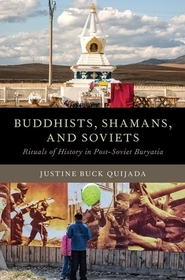
Buddhists, Shamans, and Soviets
Rituals of History in Post-Soviet Buryatia
Series: Oxford Ritual Studies Series;
- Publisher's listprice GBP 35.99
-
16 249 Ft (15 475 Ft + 5% VAT)
The price is estimated because at the time of ordering we do not know what conversion rates will apply to HUF / product currency when the book arrives. In case HUF is weaker, the price increases slightly, in case HUF is stronger, the price goes lower slightly.
- Discount 10% (cc. 1 625 Ft off)
- Discounted price 14 624 Ft (13 928 Ft + 5% VAT)
Subcribe now and take benefit of a favourable price.
Subscribe
16 249 Ft

Availability
printed on demand
Why don't you give exact delivery time?
Delivery time is estimated on our previous experiences. We give estimations only, because we order from outside Hungary, and the delivery time mainly depends on how quickly the publisher supplies the book. Faster or slower deliveries both happen, but we do our best to supply as quickly as possible.
Product details:
- Publisher OUP USA
- Date of Publication 10 December 2020
- ISBN 9780197536421
- Binding Paperback
- No. of pages258 pages
- Size 231x155x15 mm
- Weight 386 g
- Language English
- Illustrations 47 black and white illustrations 44
Categories
Short description:
Buddhists, Shamans, and Soviets examines indigenous, post-Soviet religious revival in the Republic of Buryatia through the lens of Bakhtin's chronotope. Comparing histories from Buddhist, shamanic and civic rituals, Quijada offers a new lens for analyzing ritual and an innovative approach to the ethnographic study of how people know their past.
MoreLong description:
History in the Soviet Union was a political project. From the Soviet perspective, Buryats, an indigenous Siberian ethnic group, were a "backwards" nationality that was carried along on the inexorable march towards the Communist utopian future. When the Soviet Union ended, the Soviet version of history lost its power and Buryats, like other Siberian indigenous peoples, were able to revive religious and cultural traditions that had been suppressed by the Soviet state. In the process, they also recovered knowledge about the past that the Soviet Union had silenced. Borrowing the analytic lens of the chronotope from Bakhtin, Quijada argues that rituals have chronotopes which situate people within time and space. As they revived rituals, Post-Soviet Buryats encountered new historical information and traditional ways of being in time that enabled them to re-imagine the Buryat past, and what it means to be Buryat. Through the temporal perspective of a reincarnating Buddhist monk, Dashi-Dorzho Etigelov, Buddhists come to see the Soviet period as a test on the path of dharma. Shamanic practitioners, in contrast, renegotiate their relationship to the past by speaking to their ancestors through the bodies of shamans. By comparing the versions of history that are produced in Buddhist, shamanic and civic rituals, Buddhists, Shamans and Soviets offers a new lens for analyzing ritual, a new perspective on how an indigenous people grapples with a history of state repression, and an innovative approach to the ethnographic study of how people know about the past.
Buddhists, Shamans, and Soviets not only offers a fresh and insightful approach to post -- Soviet Buryatia. It is a field building study that will surely inspire future studies of history making in the ruins of authoritarian regimes still haunted by the dead.
Table of Contents:
Acknowledgements
Note on Transliterations, Translations and Photographs
Chronology
Introduction: If you want to have a future you have to have a good relationship to your past
Chapter 1: An Inauguration for Etigelov: Multiple Genres of History in Buryatia
Chapter 2: Soviet Selves: Victory Day
Chapter 3: City Day, Hospitality, the Friendship of the Peoples and Multikulturalizm
Chapter 4: Etigelov at Maidari: The Once and Future Buddhist
Chapter 5: Opening the Center, Opening the Roads
Chapter 6: Porous Selves: Yuri's Initiation
Epilogue
Bibliography
Notes
Index

