

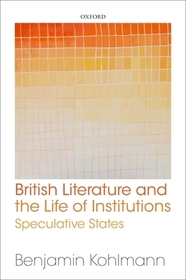
British Literature and the Life of Institutions
Speculative States
- Publisher's listprice GBP 92.00
-
43 953 Ft (41 860 Ft + 5% VAT)
The price is estimated because at the time of ordering we do not know what conversion rates will apply to HUF / product currency when the book arrives. In case HUF is weaker, the price increases slightly, in case HUF is stronger, the price goes lower slightly.
- Discount 10% (cc. 4 395 Ft off)
- Discounted price 39 558 Ft (37 674 Ft + 5% VAT)
Subcribe now and take benefit of a favourable price.
Subscribe
43 953 Ft

Availability
Estimated delivery time: In stock at the publisher, but not at Prospero's office. Delivery time approx. 3-5 weeks.
Not in stock at Prospero.
Why don't you give exact delivery time?
Delivery time is estimated on our previous experiences. We give estimations only, because we order from outside Hungary, and the delivery time mainly depends on how quickly the publisher supplies the book. Faster or slower deliveries both happen, but we do our best to supply as quickly as possible.
Product details:
- Publisher OUP Oxford
- Date of Publication 30 November 2021
- ISBN 9780198836179
- Binding Hardback
- No. of pages282 pages
- Size 242x164x22 mm
- Weight 558 g
- Language English 167
Categories
Short description:
Explores how late Victorian, Edwardian, and modernist literary texts responded and adapted to institutional change that characterized the emergence of the welfare state, and links the development of the institutional forms of the state to the aesthetic forms of literary writing.
MoreLong description:
British Literature and the Life of Institutions charts a literary prehistory of the welfare state in Britain around 1900, but it also marks a major intervention in current theoretical debates about critique and the dialectical imagination. By placing literary studies in dialogue with political theory, philosophy, and the history of ideas, the book reclaims a substantive reformist language that we have ignored to our own loss. This reformist idiom made it possible to imagine the state as a speculative and aspirational idea--as a fully realized form of life rather than as an uninspiring ensemble of administrative procedures and bureaucratic processes. This volume traces the resonances of this idiom from the Victorian period to modernism, ranging from Mary Augusta Ward, George Gissing, and H. G. Wells, to Edward Carpenter, E. M. Forster, and Virginia Woolf. Compared to this reformist language, the economism that dominates current debates about the welfare state signals an impoverishment that is at once intellectual, cultural, and political. Critiquing the shortcomings of the welfare state comes naturally to us, but we often struggle to offer up convincing defences of its principles and aims. This book intervenes in these debates by urging a richer understanding of critique: if we want to defend the state, Kohlmann argues, we need to learn to think about it again.
An important contribution to the literary and intellectual history of Britain in the late nineteenth and early twentieth centuries, as well as to contemporary debates on critique and post-critique. Focusing on a constellation of thinkers and writers who gave voice to a reformist imaginary, Kohlmann helps us to think about reform and the state anew. A powerful defense of the slow politics of progressive reform informed by aspirations to live otherwise.
Table of Contents:
Introduction: Thinking the State (Again)
Literature as Speculative Thought: Britain's Long Hegelian Moment, c.1900
"The Hope of Pessimism": George Gissing, Mary Ward, and the Idea of an Institution
"True Ownership": Edward Carpenter and the Nationalization of Land
"Kinetic" Reform: H. G. Wells and Redistributive Taxation
Welfare State Romance: E. M. Forster and Unemployment Insurance
Coda: Reformist Legacies

