

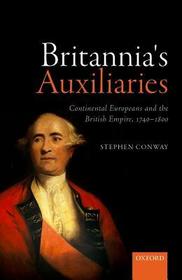
Britannia's Auxiliaries
Continental Europeans and the British Empire, 1740-1800
- Publisher's listprice GBP 102.50
-
48 969 Ft (46 637 Ft + 5% VAT)
The price is estimated because at the time of ordering we do not know what conversion rates will apply to HUF / product currency when the book arrives. In case HUF is weaker, the price increases slightly, in case HUF is stronger, the price goes lower slightly.
- Discount 10% (cc. 4 897 Ft off)
- Discounted price 44 072 Ft (41 973 Ft + 5% VAT)
Subcribe now and take benefit of a favourable price.
Subscribe
48 969 Ft

Availability
printed on demand
Why don't you give exact delivery time?
Delivery time is estimated on our previous experiences. We give estimations only, because we order from outside Hungary, and the delivery time mainly depends on how quickly the publisher supplies the book. Faster or slower deliveries both happen, but we do our best to supply as quickly as possible.
Product details:
- Publisher OUP Oxford
- Date of Publication 26 October 2017
- ISBN 9780198808701
- Binding Hardback
- No. of pages250 pages
- Size 241x163x21 mm
- Weight 534 g
- Language English
- Illustrations 3 black and white images 0
Categories
Short description:
How did continental Europeans contribute to the eighteenth-century British Empire? Stephen Conway observes how European settlers, soldiers, scientists, sailors, clergymen, merchants, and technical experts contributed to the British Empire, and how they were shaped by imperial direction and control.
MoreLong description:
Britannia's Auxiliaries provides the first wide-ranging attempt to consider the continental European contribution to the eighteenth-century British Empire. The British benefited from many European inputs - financial, material, and, perhaps most importantly, human. Continental Europeans appeared in different British imperial sites as soldiers, settlers, scientists, sailors, clergymen, merchants, and technical experts. They also sustained the empire from outside - through their financial investments, their consumption of British imperial goods, their supply of European products, and by aiding British imperial communication. Continental Europeans even provided Britons with social support from their own imperial bases.
The book explores the means by which continental Europeans came to play a part in British imperial activity at a time when, at least in theory, overseas empires were meant to be exclusionary structures, intended to serve national purposes. It looks at the ambitions of the continental Europeans themselves, and at the encouragement given to their participation by both private interests in the British Empire and by the British state.
Despite the extensive involvement of continental Europeans, the empire remained essentially British. Indeed, the empire seems to have changed the Europeans who entered it more than they changed the empire. Many of them became at least partly Anglicized by the experience, and even those who retained their national character usually came under British direction and control.
This study, then, qualifies recent scholarly emphasis on the transnational forces that undermined the efforts of imperial authorities to maintain exclusionary empires. In the British case, at least, the state seems, for the most part, to have managed the process of continental involvement in ways that furthered British interests. In this sense, those foreign Europeans who involved themselves in or with the British Empire, whatever their own perspective, acted as Britannia's auxiliaries.
Table of Contents:
Introduction
Inside the Empire
Outside the Empire
Ambitions and Opportunities
Networks
Government
British Empire
Conclusions
Archival Sources
Index

