

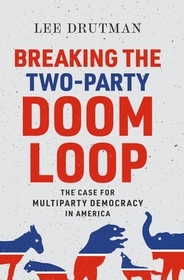
Breaking the Two-Party Doom Loop
The Case for Multiparty Democracy in America
- Publisher's listprice GBP 16.49
-
7 878 Ft (7 502 Ft + 5% VAT)
The price is estimated because at the time of ordering we do not know what conversion rates will apply to HUF / product currency when the book arrives. In case HUF is weaker, the price increases slightly, in case HUF is stronger, the price goes lower slightly.
- Discount 10% (cc. 788 Ft off)
- Discounted price 7 089 Ft (6 752 Ft + 5% VAT)
Subcribe now and take benefit of a favourable price.
Subscribe
7 878 Ft

Availability
Estimated delivery time: In stock at the publisher, but not at Prospero's office. Delivery time approx. 3-5 weeks.
Not in stock at Prospero.
Why don't you give exact delivery time?
Delivery time is estimated on our previous experiences. We give estimations only, because we order from outside Hungary, and the delivery time mainly depends on how quickly the publisher supplies the book. Faster or slower deliveries both happen, but we do our best to supply as quickly as possible.
Product details:
- Publisher OUP USA
- Date of Publication 6 July 2022
- ISBN 9780197577547
- Binding Paperback
- No. of pages400 pages
- Size 236x156x27 mm
- Weight 594 g
- Language English
- Illustrations 20 b&w figures 235
Categories
Short description:
American democracy is in crisis, but nobody seems to know what to do about it. Breaking the Two-Party Doom Loop offers a big and bold plan. The true crisis of American democracy is that two parties are too few. Deftly weaving together history, theory and political science research, Drutman shows the only to break the binary, zero-sum toxic partisanship is to break it apart. America needs more partisanship, rather than less, but in the form of more parties. In this wide-ranging, learned, but highly accessible book, Drutman charts an exciting path forward that might just save the country.
MoreLong description:
A compelling case for large-scale electoral reform.
American democracy is at an impasse. After years of zero-sum partisan trench warfare, our political institutions are deteriorating. Our norms are collapsing. Democrats and Republicans no longer merely argue; they cut off contact with each other. In short, the two-party system is breaking our democracy, and driving us all crazy.
Deftly weaving together history, democratic theory, and cutting edge political science research, Drutman tells the story of how American politics became so toxic, why the country is trapped in a doom loop of escalating two-party warfare, and why it is destroying the shared sense of fairness and legitimacy on which democracy depends. He argues that the only way out is to have more partisanship-more parties, to short-circuit the zero-sum nature of binary partisan conflict. American democracy was once stable because the two parties held within them multiple factions, which made it possible to assemble flexible majorities and kept the temperature of political combat from overheating. But as conservative Southern Democrats and liberal Northeastern Republicans disappeared, partisan conflict flattened and pulled apart. Once the parties fully separated, toxic partisanship took over. With the two parties divided over competing visions of national identity, Democrats and Republicans no longer see each other as opponents, but as enemies. And the more the conflict escalates, the shakier our democracy feels.
Breaking the Two-Party Doom Loop makes a compelling case for large-scale electoral reform--importantly, reform not requiring a constitutional amendment-that would give America more parties, making American democracy more representative, more responsive, and ultimately more stable.
Highly Recommended.
Table of Contents:
Preface
Introduction
PART I: Origins
1 - What the Framers Got Right and What They Got Wrong
2 - The Paradox of Partisanship
3 - The Great Reordering of the Parties
4 - The Collpase of the Four-Party System and the Rise of Zero-Sum Politics
PART II: The Contemporary Crisis
5 - The New Era of Toxic Politics
6 - All Politics Is Conflict; Not All Confllict Is Toxic
7 - The Breakdown of Political Fairness
PART III: The Solution
8 - Designing the Save American Democracy Act
9 - Two Few: The Case for Multiparty Democracy in America
10 - The Politics of Electoral Reform
11 - The Future of American Democracy
Afterword
Acknowledgments
Notes Index

