

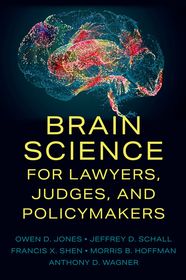
Brain Science for Lawyers, Judges, and Policymakers
- Publisher's listprice GBP 26.99
-
12 185 Ft (11 605 Ft + 5% VAT)
The price is estimated because at the time of ordering we do not know what conversion rates will apply to HUF / product currency when the book arrives. In case HUF is weaker, the price increases slightly, in case HUF is stronger, the price goes lower slightly.
- Discount 10% (cc. 1 218 Ft off)
- Discounted price 10 967 Ft (10 445 Ft + 5% VAT)
Subcribe now and take benefit of a favourable price.
Subscribe
12 185 Ft

Availability
printed on demand
Why don't you give exact delivery time?
Delivery time is estimated on our previous experiences. We give estimations only, because we order from outside Hungary, and the delivery time mainly depends on how quickly the publisher supplies the book. Faster or slower deliveries both happen, but we do our best to supply as quickly as possible.
Product details:
- Publisher OUP USA
- Date of Publication 19 June 2024
- ISBN 9780197748862
- Binding Paperback
- No. of pages160 pages
- Size 226x147x10 mm
- Weight 227 g
- Language English
- Illustrations 21 497
Categories
Short description:
This book provides a user-friendly introduction to the fundamentals of neuroscience for lawyers, advocates, judges, legal academics, and policymakers.
MoreLong description:
Brain science in the form of neuroscientific evidence now appears frequently in courtrooms and policy discussions alike. Many legal issues are at stake, such as how to separate the best uses of brain science information from those that are potentially biasing or misleading. It is crucial to evaluate brain science evidence in light of relevant legal standards (such as the Daubert and Frye Rules).
Brain Science for Lawyers, Judges, and Policymakers responds to this rapidly changing legal landscape, providing a user-friendly introduction to the fundamentals of neuroscience for lawyers, advocates, judges, legal academics, and policymakers. It features detailed but clear illustrations, as well as a comprehensive and accessible overview of developments in legally relevant neuroscience. Readers will learn brain science terms, how to understand and discuss brain structure and function in legally relevant contexts, and how to avoid over- or under-interpreting neuroscientific evidence.
The book begins with a survey of the kinds of litigation, legislation, and regulation where neuroscience is currently being used. It provides accessible descriptions of basic brain anatomy and brain function as well as an overview of how modern technologies can reveal the brain structures and brain functions of individuals. It finishes with cautions and limitations, including timely and thought-provoking observations about where the future of neurolaw might lead. Throughout, the authors offer clear and concise guidance on understanding both the promise and the limitations of using brain science in law and policymaking.
Extremely useful for the average lawyer, this handy primer talks us through the basic structures and functions of the brain in a clear and interesting way. I found this to be a very helpful guide.
Table of Contents:
Foreword
Chapter 1: Where We Are Now
Chapter 2: Overview of the Brain
Chapter 3: The Cerebral Cortex
Chapter 4: The Interior of the Brain
Chapter 5: How Neurons Work
Chapter 6: Technologies that Reveal Brain Structures
Chapter 7: Technologies that Reveal Brain Functions
Chapter 8: Changing Brain Functions
Chapter 9: Limitations and Cautions
Chapter 10: Where We Might Be Headed
Afterword
Further Readings and Resources
Glossary

