

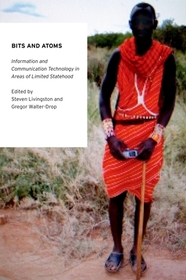
Bits and Atoms
Information and Communication Technology in Areas of Limited Statehood
Series: Oxford Studies in Digital Politics;
- Publisher's listprice GBP 32.49
-
14 669 Ft (13 970 Ft + 5% VAT)
The price is estimated because at the time of ordering we do not know what conversion rates will apply to HUF / product currency when the book arrives. In case HUF is weaker, the price increases slightly, in case HUF is stronger, the price goes lower slightly.
- Discount 10% (cc. 1 467 Ft off)
- Discounted price 13 202 Ft (12 573 Ft + 5% VAT)
Subcribe now and take benefit of a favourable price.
Subscribe
14 669 Ft

Availability
printed on demand
Why don't you give exact delivery time?
Delivery time is estimated on our previous experiences. We give estimations only, because we order from outside Hungary, and the delivery time mainly depends on how quickly the publisher supplies the book. Faster or slower deliveries both happen, but we do our best to supply as quickly as possible.
Product details:
- Publisher OUP USA
- Date of Publication 23 January 2014
- ISBN 9780199941612
- Binding Paperback
- No. of pages208 pages
- Size 160x234x12 mm
- Weight 272 g
- Language English 0
Categories
Short description:
Bits and Atoms explores the governance potential found in the explosive growth of digital information and communication technology in areas of limited statehood. The chapters explore when and if the growth in digital technology can fill some of the governance vacuum created by the absence of an effective state.
MoreLong description:
Bits and Atoms explores the governance potential found in the explosive growth of digital information and communication technology in areas of limited statehood. Today, places with weak or altogether missing state institutions are tied internally and to the larger world by widely available digital technology. The chapters in the book explore questions of when and if the growth in digital technology can fill some of the governance vacuum created by the absence of an effective state. For example, mobile money could fill a gap in traditional banking or mobile phones could allow rural populations to pay for basic services and receive much needed advice and market pricing information. Yet, as potentially revolutionary as this technology can be to areas of limited statehood, it still faces limitations. Bits and Atoms is a thought-provoking look at the prospects for and limitations of digital technology to function in place of traditional state apparatuses.
This pathbreaking book brings an innovative group of scholars and practitioners together to explore ways in which information and communication technologies are addressing governance problems that occur when states fail to deliver basic services or provide acceptable levels of social order and public input. The diverse cases illustrate both the capacities and limits of communication technologies in building various forms of social and political organization. These studies cast a much needed light on the spectrum of political problems and creative possibilities that shape the lives of the majority of people living outside of functional democratic political regimes. The book adds significantly to how we think about governance, the role of technology in social and political organization, and the nature of political communication.
Table of Contents:
Foreward
Sina Odugbemi
Chapter 1: Introduction
Steven Livingston and Gregor Walter-Drop
Part 1: Simulation, Consolidation, Opposition: ICT and Limited Statehood
Chapter 2: Information Technology and the Limited States of the Arab Spring
Muzammil M. Hussain and Philip N. Howard
Chapter 3: The Kremlin's Cameras and Virtual Potemkin Villages: ICT and the Construction of Statehood
Gregory Asmolov
Chapter 4: E-government as a Means of Development in India
J. P. Singh
Chapter 5: ICT and Accountability in Areas of Limited Statehood
Joseph Siegle
Part 2: Substitution: ICT as a Tool for Non-State Governance
Chapter 6: FrontlineSMS, Mobile-for-Development and the 'long tail' of governance
Sharath Srinivasan
Chapter 7: Natural Disasters and Alternative Modes of Governance: the Role of Social Networks and Crowdsourcing Platforms in Russia
Gregory Asmolov
Chapter 8: Mapping Kibera. Empowering Slum Residents by ICT
Primo%z Kova?i? and Jamie Lundine
Chapter 9: Crisis Mapping in Areas of Limited Statehood
Patrick Meier
Chapter 10: From Crowdsourcing to Crowdseeding: The Cutting Edge of Empowerment?
Peter van der Windt
Chapter 11: Conclusions
Steven Livingston and Gregor Walter-Drop
Notes
References
Index

