

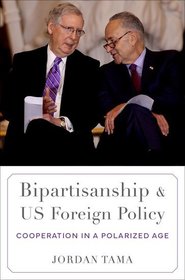
Bipartisanship and US Foreign Policy
Cooperation in a Polarized Age
- Publisher's listprice GBP 68.00
-
32 487 Ft (30 940 Ft + 5% VAT)
The price is estimated because at the time of ordering we do not know what conversion rates will apply to HUF / product currency when the book arrives. In case HUF is weaker, the price increases slightly, in case HUF is stronger, the price goes lower slightly.
- Discount 10% (cc. 3 249 Ft off)
- Discounted price 29 238 Ft (27 846 Ft + 5% VAT)
Subcribe now and take benefit of a favourable price.
Subscribe
32 487 Ft

Availability
printed on demand
Why don't you give exact delivery time?
Delivery time is estimated on our previous experiences. We give estimations only, because we order from outside Hungary, and the delivery time mainly depends on how quickly the publisher supplies the book. Faster or slower deliveries both happen, but we do our best to supply as quickly as possible.
Product details:
- Publisher OUP USA
- Date of Publication 1 September 2023
- ISBN 9780197745663
- Binding Hardback
- No. of pages332 pages
- Size 156x235x23 mm
- Weight 599 g
- Language English
- Illustrations 14 b/w line drawings; 18 tables 475
Categories
Short description:
Although Democrats and Republicans in Washington appear to live in different realities today, they often cooperate when they turn their attention overseas. In Bipartisanship and US Foreign Policy, Jordan Tama examines the surprising persistence of foreign policy cooperation between Democrats and Republicans, even as partisan polarization in American politics reaches new heights. Drawing on new data on congressional voting, in-depth case studies of major recent foreign policy debates, and interviews of more than 100 foreign policy practitioners, the book shows that it remains possible for members of the two parties to band together to shape the US role in the world.
MoreLong description:
In an era of ever-increasing polarization in the US Congress, American foreign policy remains marked by frequent bipartisanship. In Bipartisanship and US Foreign Policy, Jordan Tama shows that, even as polarization in American politics reaches new heights, Democrats and Republicans in Washington continue to cooperate on important international issues. Looking closely at congressional voting patterns and recent debates over military action, economic sanctions, international trade, and foreign policy spending, Tama reveals that bipartisanship remains surprisingly common when US elected officials turn their attention overseas. Yet bipartisanship today rarely involves complete unity. Instead, bipartisan coalitions spanning members of both parties often coexist with intra-party divisions or disagreement between Congress and the president, making it difficult for the United States to speak with one voice on the global stage. Drawing on new data and interviews of more than 100 foreign policy practitioners, this book documents the persistence of bipartisanship on international issues and highlights key factors that facilitate or impede cooperation on foreign policy challenges.
Polarization has certainly undermined partisan comity but Jordan Tama's careful and illuminating research demonstrates that Democrats and Republicans in Congress still vote together on foreign policy issues surprisingly often. Tama's explanation for the persistence of bipartisanship is a major contribution to research on the politics of foreign policy.
Table of Contents:
Acknowledgments
Part 1: Concepts and Patterns
Chapter 1: The Persistence and Forms of Bipartisanship
Chapter 2: Bipartisanship in Congressional Voting
Chapter 3: Enablers of Bipartisanship
Part 2: Case Studies from the Obama and Trump Years
Chapter 4: Military Intervention in Syria
Chapter 5: War Powers Authorities
Chapter 6: Sanctions on Russia
Chapter 7: Sanctions on Iran
Chapter 8: The Trans-Pacific Partnership and International Trade
Chapter 9: Spending on Foreign Aid and Diplomacy
Part 3: Conclusions
Chapter 10: Implications and Bipartisanship under Biden
References
Notes
Index

