

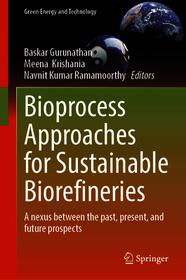
Bioprocess Approaches for Sustainable Biorefineries
A nexus between the past, present, and future prospects
Series: Green Energy and Technology;
- Publisher's listprice EUR 246.09
-
96 122 Ft (91 545 Ft + 5% VAT)
The price is estimated because at the time of ordering we do not know what conversion rates will apply to HUF / product currency when the book arrives. In case HUF is weaker, the price increases slightly, in case HUF is stronger, the price goes lower slightly.
- Discount 12% (cc. 11 534 Ft off)
- Discounted price 84 588 Ft (80 560 Ft + 5% VAT)
Subcribe now and take benefit of a favourable price.
Subscribe
84 588 Ft

Availability
Not yet published.
Why don't you give exact delivery time?
Delivery time is estimated on our previous experiences. We give estimations only, because we order from outside Hungary, and the delivery time mainly depends on how quickly the publisher supplies the book. Faster or slower deliveries both happen, but we do our best to supply as quickly as possible.
Product details:
- Publisher Springer Nature Singapore
- Date of Publication 19 July 2026
- ISBN 9789819595273
- Binding Hardback
- No. of pages447 pages
- Size 235x155 mm
- Language English
- Illustrations X, 447 p. 49 illus., 44 illus. in color. 700
Categories
Long description:
Biofuels and Biorefineries have been in vogue for centuries but are still confronted with techno-economic hurdles on their way to full-fledged commercialization. Considering a holistic approach, this book provides a comprehensive overview of the reported processes and contemporary improvements, providing futuristic insights into the creation of high-throughput process pipelines in the realm of biofuels. The 15 individual chapters presented here encompass critical industrial aspects, commencing from: deciphering the contemporary global status of biofuel research with a scientometric overview; offering solutions for plant biomass management, discussing problem-solving approaches related to cellulolytic fungal diversity and the second-generation ethanol’s production; analyses of select hydrogen production technologies, specially blue-hydrogen; hydrothermal liquefaction; microbes’ genetic manipulation-driven biorefineries, exploration of algal biomasses’ diversity, and their engineered use for biomass-based fuels; integrated techniques for carbon sequestration and utilization; the rapid implementation of artificial intelligence in biorefineries. This book can serve as a learning resource and reference material for biofuel researchers and scientists, and the new-generation research fraternity, which looks forward to pursing biofuel-related research in the future.
MoreTable of Contents:
Section 1: Revisiting established biorefineries, their related research, contemporary approaches and futuristic concepts for their improved sustainability.- Chapter 1: Global biorefinery research: A scientometric overview.- Chapter 2: Current state of the global biorefinery research.- Chapter 3: “BioAIchemy”: Transforming Biorefineries’ Efficiency and Productivity.- Section 2: Efficient utilization of algal, fungal, and lignocellulosic biomass for biorefinery processes pertaining to the production of biocrude, biodiesel, bioethanol, biobutanol, biohydrogen, and bioammonia.- Chapter 4: Microbial biorefineries – Industrial workhorses for a futuristic fuel’s pursuit.- Chapter 5: Microbe-based biorefineries – fuelling the way forward to crude oil crisis.- Chapter 6: Exploring microalgal diversity for the conversion of their biomass to biofuels.- Chapter 7: Biocrude – A “Carbon Copy” of the conventional crude oil.- Chapter 8: Biocrude: A sustainable analog to fossil fuel.- Chapter 9: Nature’s Naphtha: A Biodegradable alternate.- Chapter 10: Fungi as biofactories for sustainable biofuel: Innovations and applications in Biotechnology.- Chapter 11: Improving the Robustness of Bioethanol Production: Innovative Methods and Advancements.- Chapter 12: Cellulolytic enzyme complexes and 2G (second-generation) bio-refineries: A problem-solving approach covering unexplored cellulolytic fungal diversity.- Chapter 13: Streamlining Biobutanol Production: Innovations for Cost-effective biofuel.- Chapter 14: Bioprocessing in Hydrogen Production: Review of Feedstock, Efficiency, and Valorization of Waste as an Alternative Production Route for Carbon-free Future Fuel.- Chapter 15: Sustainable Hydrogen Solutions: Bio, Green, and Blue Pathways.- Chapter 16: A Deep-dive into blue hydrogen – shifting to a better future.- Chapter 17: Green Ammonia: A sustainable pathway for clean energy.- Section 3: Unconventional biomass sources, integrated processes, carbon sequestration, genetic engineering strategies, and the production of value-added products for improved valorization of bioresources.- Chapter 18: Integrating Unconventional, Genetically-manipulated biomass, and Waste-derived biomass Solutions for Biorefineries.- Chapter 19: Unlocking the potential of unconventional biomass for sustainable biofuel production.- Chapter 20: Valorization of waste biomass sources to biofuels, bioenergy and biomaterials: Integration of conversion technologies.- Chapter 21: Integrated Carbon Sequestration and Biorefinery Operations for Sustainable Biofuel Production.- Chapter 22: Genetic Engineering of Microalgae for Enhanced Biodiesel Production: Strategies and Advances.- Chapter 23: Genetic Engineering Strategies for Optimizing Bioethanol Production: Innovations and Future Directions.- Chapter 24: Advancements in metabolic engineering and synthetic biology for production of next-generation biofuels.- Chapter 25: Multi-omics approaches for the improvement of Biofuel in microalgae.- Chapter 26: Green Solutions for Sustainable Plant-Biomass Management in Biorefineries.- Chapter 27: Advancing Sustainable Biomanufacturing: Integrating Algae-based biorefinery with genetic engineering.
More
