
• Contact

  • Newsletter

  • About us

  • Delivery options

  • Prospero Book Market Podcast

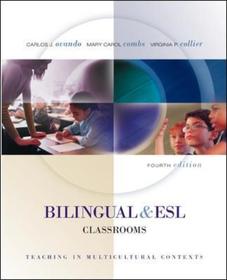
  • Bilingual and ESL Classrooms: Teaching in Multicultural Contexts

    Bilingual and ESL Classrooms: Teaching in Multicultural Contexts by Ovando, Carlos J.; Collier, Virginia P.; Combs, Mary Carol;

      • GET 10% OFF

      • The discount is only available for 'Alert of Favourite Topics' newsletter recipients.
      • Publisher's listprice GBP 77.99
      • The price is estimated because at the time of ordering we do not know what conversion rates will apply to HUF / product currency when the book arrives. In case HUF is weaker, the price increases slightly, in case HUF is stronger, the price goes lower slightly.

        37 259 Ft (35 485 Ft + 5% VAT)
      • Discount 10% (cc. 3 726 Ft off)
      • Discounted price 33 533 Ft (31 937 Ft + 5% VAT)

    37 259 Ft

    Availability

    Out of print

    Why don't you give exact delivery time?

    Delivery time is estimated on our previous experiences. We give estimations only, because we order from outside Hungary, and the delivery time mainly depends on how quickly the publisher supplies the book. Faster or slower deliveries both happen, but we do our best to supply as quickly as possible.

    Product details:

    • Edition number 4
    • Publisher McGraw-Hill
    • Date of Publication 1 August 2005

    • ISBN 9780072982367
    • Binding Paperback
    • No. of pages544 pages
    • Size 231x185x20 mm
    • Weight 778 g
    • Language English
    • 0

    Categories

    Long description:

    Demographic predictions are that students with close connections to their bilingual/bicultural heritages (now labeled ?language minority students? by the federal government) will be very large in number in the near future, becoming the majority in many states over the next three decades. The authors feel it is the responsibility of all educators, not just specialists, to prepare themselves to work with language minority students. This time-tested classic text (not an edited volume) integrates theory and practice and provides comprehensive coverage of bilingual and ESL issues. The text integrates the fields of ESL, bilingual, and multicultural education and provides rich examples of effective practices and their underlying research knowledge base and provides an extremely clear and balanced overview of research on teaching in multilingual and multicultural contexts

    Demographic predictions are that students with close connections to their bilingual/bicultural heritages (now labeled ?language minority students? by the federal government) will be very large in number in the near future, becoming the majority in many states over the next three decades. The authors feel it is the responsibility of all educators, not just specialists, to prepare themselves to work with language minority students. This time-tested classic text (not an edited volume) integrates theory and practice and provides comprehensive coverage of bilingual and ESL issues. The text integrates the fields of ESL, bilingual, and multicultural education and provides rich examples of effective practices and their underlying research knowledge base and provides an extremely clear and balanced overview of research on teaching in multilingual and multicultural contexts

    More

    Table of Contents:

    Preface

    Foreward

    Prologue: Carlos's Story

    Chapter 1: Students

    What Do We Mean by Bilingual Education and ESL?

    Demographics

    Types of Language Minority Students

    Student and Family Background

    What Happens at School

    Discovering the Student

    Program Models

    ESL Pullout

    Newcomer Programs

    Summary

    Key Terms

    Reflection Questions

    Resources

    Chapter 2: Policy and Programs

    The Politics of Bilingual Education

    Historical Background

    Historical Overview of Title VII Legislation, 1968-2001

    "No Child Left Behind" (PL 107-110, 115 Stat. 1425, 2002)

    Court Decisions and the Office for Civil Rights

    State Policies

    Leading School Reform at the Local Level

    Summary

    Key Terms

    Reflection Questions

    Resources

    Chapter 3: Teaching

    Portrait of a Traditional Classroom

    The Workplace of the Twenty-first Century

    Passive Learning

    Active, Inquiry-Based Learning

    Activating Students' Prior Knowledge

    Cooperative Learning

    Accelerated Learning

    Critical Pedagogy

    Art

    Technology

    Music

    Weaving It All Together

    Summary

    Key Terms

    Reflection Questions

    Resources

    Chapter 4: Language

    Language Acquistion

    Interdependence of First and Second Languages

    Second-Language Acquistion as a Natural, Developmental Process

    Instructional Approaches to Teaching a Second Language

    Teaching Language Arts in a Bilingual Classroom

    Language and Multicultural Literature across the Curriculm

    Summary

    Key Terms

    Reflection Questions

    Resources

    Chapter 5: Culture

    Perspectives on the Concept of Culture

    Processes in the Development of Cultural Identities

    Multicultural Education

    Prejudice and Discrimination

    The Role of Culture in Language Minority Achievement

    Ethnographic Approaches to Cultural Understanding

    Summary

    Key Terms

    Reflection Questions

    Resources

    Chapter 6: Mathematics and Science

    Achievement of Language Minority Students in Mathematics and Science

    Current Standards and Math and Science Reform

    Opportunity to Learn Standards

    Language in Mathematics and Science Classrooms

    Cultural Issues in Mathematics and Science

    A Theme-Based Approach: Science, Technology, and Society

    Summary

    Key Terms

    Reflection Questions

    Resources

    Chapter 7: Social Studies

    Multiple Perspectives: A Framework for Social Studies

    Classroom Settings for Bilingual and ESL Social Studies

    Methods for Social Studies Instruction

    Critical Thinking and Study Skills Development

    Paying Attention to Social Studies Language Issues

    Theme-Based, Integrated Social Studies Units

    Summary

    Key Terms

    Reflection Questions

    Resources

    Chapter 8: Assessment

    Context for Assessment

    Basic Assessment Concepts

    Types of Assessments

    School-Based Assessment

    Classroom-Based Assessment

    Linking Assessment to Instruction

    Need for Long-Term Professional Development

    Summary

    Key Terms

    Reflection Questions

    Resources

    Chapter 9: Bilingual Special Education

    Foundations for Bilingual Special Education

    Current Educational Policies

    English Language Learners in Special Education

    Understanding the Prereferraal, Evaluation and Placement Processes

    Rethinking Identification and Referrals of English Language Learners for Special Education Services

    Summary

    Key Terms

    Reflection Questions

    Resources

    Chapter 10: School and Community

    Examples of Community Programs

    The Historical Context of Language Minority Communities

    Developing a Portrait of the Community

    Pathways to Partnerships

    Summary

    Key Terms

    Reflection Questions

    Resources

    Afterword

    Glossary

    References

    Credits

    Index

    More

    0