

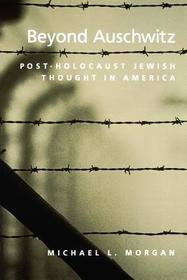
Beyond Auschwitz
Post-Holocaust Jewish Thought in America
- Publisher's listprice GBP 41.49
-
18 732 Ft (17 840 Ft + 5% VAT)
The price is estimated because at the time of ordering we do not know what conversion rates will apply to HUF / product currency when the book arrives. In case HUF is weaker, the price increases slightly, in case HUF is stronger, the price goes lower slightly.
- Discount 10% (cc. 1 873 Ft off)
- Discounted price 16 859 Ft (16 056 Ft + 5% VAT)
Subcribe now and take benefit of a favourable price.
Subscribe
18 732 Ft

Availability
printed on demand
Why don't you give exact delivery time?
Delivery time is estimated on our previous experiences. We give estimations only, because we order from outside Hungary, and the delivery time mainly depends on how quickly the publisher supplies the book. Faster or slower deliveries both happen, but we do our best to supply as quickly as possible.
Product details:
- Publisher OUP USA
- Date of Publication 25 October 2001
- ISBN 9780195148626
- Binding Paperback
- No. of pages304 pages
- Size 226x150x22 mm
- Weight 431 g
- Language English 0
Categories
Short description:
This book offers the first comprehensive overview of Post-Holocaust Jewish theology, quoting extensively from and interpreting all of the significant American writings of the movement. Morgan's lucid analysis clarifies the background of the movement in the postwar period, its origins, its character, and its legacy for subsequent thinking, theological and otherwise. Among the authors whose work he considers are Hannah Arendt, Richard Rubenstein, Eliezer Berkowitz, Irving Greenberg, Arthur Cohen, Emil Fackenheim, Eli Wiesel and many others. Ultimately, Morgan's primary purpose is to tell the story of the movement, to illuminate its real, deep point, and to demonstrate its continuing relevance today.
MoreLong description:
This book offers the first comprehensive overview of Post-Holocaust Jewish theology, quoting extensively from and interpreting all of the significant American writings of the movement. Morgan's lucid analysis clarifies the background of the movement in the postwar period, its origins, its character, and its legacy for subsequent thinking, theological and otherwise. Among the authors whose work he considers are Hannah Arendt, Richard Rubenstein, Eliezer Berkowitz, Irving Greenberg, Arthur Cohen, Emil Fackenheim, Eli Wiesel and many others. Ultimately, Morgan's primary purpose is to tell the story of the movement, to illuminate its real, deep point, and to demonstrate its continuing relevance today.
This single volume, produced by an authority in the field, providing access to five seminal thinkers' ideas on identity, memory, and tradition, is welcome.

