

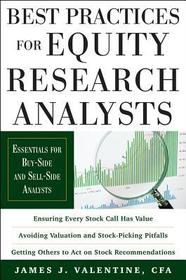
Best Practices for Equity Research Analysts: Essentials for Buy-Side and Sell-Side Analysts
Series: PROFESSIONAL FINANCE & INVESTM;
- Publisher's listprice GBP 84.99
-
38 372 Ft (36 545 Ft + 5% VAT)
The price is estimated because at the time of ordering we do not know what conversion rates will apply to HUF / product currency when the book arrives. In case HUF is weaker, the price increases slightly, in case HUF is stronger, the price goes lower slightly.
- Discount 10% (cc. 3 837 Ft off)
- Discounted price 34 535 Ft (32 891 Ft + 5% VAT)
Subcribe now and take benefit of a favourable price.
Subscribe
38 372 Ft

Availability
Out of print
Why don't you give exact delivery time?
Delivery time is estimated on our previous experiences. We give estimations only, because we order from outside Hungary, and the delivery time mainly depends on how quickly the publisher supplies the book. Faster or slower deliveries both happen, but we do our best to supply as quickly as possible.
Product details:
- Publisher McGraw Hill
- Date of Publication 16 February 2011
- ISBN 9780071736381
- Binding Hardback
- No. of pages464 pages
- Size 231x154x38 mm
- Weight 788 g
- Language English 0
Categories
Short description:
A former Morgan Stanley research analyst provides the very first real-world guide for training equity research analysts, based on industry best practices
MoreLong description:
A real-world guide to becoming a top-performing equity analyst
Praise for Best Practices for Equity Research Analysts:
"Jim Valentine has taken his decades of experience as a highly successful security analyst and written an effective and comprehensive guide to doing the job right. Ionly wish I had this book by my side throughout my career." -- Byron R. Wien, Vice Chairman, Blackstone Advisory Partners LP
"Given the fast pace and high-pressure nature of the markets, analysts don't have the luxury to make mistakes. James J. Valentine's Best Practices for Equity ResearchAnalysts should be required reading for all new and experienced analysts, particularly those who were not lucky enough to be brought up in the business under amentor. Valentine can be that mentor." -- Jami Rubin, Managing Director, Global Investment Research, Goldman Sachs
"Jim's book is an excellent window into the world of securities research. Very few works cover the complete life cycle of an analyst and the necessary balance betweentheory and practice. This is one of them." -- Juan-Luis Perez, Global Director of Research, Morgan Stanley
"Valentine's book doesn?t rehash the basics of finance but covers all the nonacademic topics in terms of how the analysts should manage their time, resources,data, and contacts in order to come up with the best stock picks. This book is required reading for beginning analysts and a must-read for all analysts who want todevelop an edge." -- Carl Schweser, Founder of Schweser?s Study Program for the CFA Exam
"Best Practices for Equity Research Analysts is by far the best written and most comprehensive book that I have read on how to become a top-notch analyst. I shouldn't be surprised; it was written by one of the best analysts that Wall Street has ever seen. Every securities firm should require their analysts to read this book." -- Eli Salzmann, Portfolio Manager
Most equity research analysts learn their trade on the job by apprenticing under a senior analyst. However, equity analysts who work for senior producers often havelittle time or incentive to train new hires, and those who do have the time may not have research skills worth emulating.
Now, Best Practices for Equity Research Analysts offers promising equity research analysts a practical curriculum for mastering their profession. James J. Valentine, a former Morgan Stanley analyst, explains everything today's competitive analyst needs to know,providing practical training materials for buyand sell-side research analysis in the United States and globally.
Conveniently organized for use as a learning tool and everyday reference on the job, Best Practices for Equity Research Analysts covers the five primary areasof the equity research analyst's role:
- Identifying and monitoring critical factors
- Creating and updating financial forecasts
- Deriving price targets or a range of targets
- Making stock recommendations
- Communicating stock ideas
Expanding upon material covered in undergraduate courses but written specifically to help you perform in the real world, this authoritative book gives you access to the wisdom and expertise of leading professionals in the field. You'll learn best practices for setting up an information hub, influencing others, identifying the critical factors and information sources for better forecasting, creating a better set of financial forecast scenarios, improving valuation and stock-picking techniques, communicating your message effectively, making ethical decisions, and more.
Without Best Practices for Equity Research Analysts, you're just treading water in the sink-or-swim world of the equity analyst.
A real-world guide to becoming a top-performing equity analyst
Praise for Best Practices for Equity Research Analysts:
"Jim Valentine has taken his decades of experience as a highly successful security analyst and written an effective and comprehensive guide to doing the job right. Ionly wish I had this book by my side throughout my career." -- Byron R. Wien, Vice Chairman, Blackstone Advisory Partners LP
"Given the fast pace and high-pressure nature of the markets, analysts don't have the luxury to make mistakes. James J. Valentine's Best Practices for Equity ResearchAnalysts should be required reading for all new and experienced analysts, particularly those who were not lucky enough to be brought up in the business under amentor. Valentine can be that mentor." -- Jami Rubin, Managing Director, Global Investment Research, Goldman Sachs
"Jim's book is an excellent window into the world of securities research. Very few works cover the complete life cycle of an analyst and the necessary balance betweentheory and practice. This is one of them." -- Juan-Luis Perez, Global Director of Research, Morgan Stanley
"Valentine's book doesn?t rehash the basics of finance but covers all the nonacademic topics in terms of how the analysts should manage their time, resources,data, and contacts in order to come up with the best stock picks. This book is required reading for beginning analysts and a must-read for all analysts who want todevelop an edge." -- Carl Schweser, Founder of Schweser?s Study Program for the CFA Exam
"Best Practices for Equity Research Analysts is by far the best written and most comprehensive book that I have read on how to become a top-notch analyst. I shouldn't be surprised; it was written by one of the best analysts that Wall Street has ever seen. Every securities firm should require their analysts to read this book." -- Eli Salzmann, Portfolio Manager
Most equity research analysts learn their trade on the job by apprenticing under a senior analyst. However, equity analysts who work for senior producers often havelittle time or incentive to train new hires, and those who do have the time may not have research skills worth emulating.
Now, Best Practices for Equity Research Analysts offers promising equity research analysts a practical curriculum for mastering their profession. James J. Valentine, a former Morgan Stanley analyst, explains everything today's competitive analyst needs to know,providing practical training materials for buyand sell-side research analysis in the United States and globally.
Conveniently organized for use as a learning tool and everyday reference on the job, Best Practices for Equity Research Analysts covers the five primary areasof the equity research analyst's role:
- Identifying and monitoring critical factors
- Creating and updating financial forecasts
- Deriving price targets or a range of targets
- Making stock recommendations
- Communicating stock ideas
Expanding upon material covered in undergraduate courses but written specifically to help you perform in the real world, this authoritative book gives you access to the wisdom and expertise of leading professionals in the field. You'll learn best practices for setting up an information hub, influencing others, identifying the critical factors and information sources for better forecasting, creating a better set of financial forecast scenarios, improving valuation and stock-picking techniques, communicating your message effectively, making ethical decisions, and more.
Without Best Practices for Equity Research Analysts, you're just treading water in the sink-or-swim world of the equity analyst.
MoreTable of Contents:
Chapter 1: Selecting the Optimal Stock Universe ? Don't Let Others Choose Your Fate; Chapter 2: Sectors Before Stocks ? Maximizing Long
-Run Performance; Chapter 3: Identify Company Factors that Drive the Stock ? The Rest Is a Waste of Time; Chapter 4: Uncover Proprietary Industry Sources for an Edge; Chapter 5: Get the Most From Interviews with Management and Information Sources; Chapter 6: Create Financial Forecasts with Just Enough Detail to Spot Anomalies; Chapter 7: Ten Practical Valuation Tools Used by the Pros; Chapter 8: Frameworks to Help Deciding Between Buy, Hold and Sell; Chapter 9: Stock Calls Need an Advocate: Influence Others to Trade Your Idea; Chapter 10: Tips to Ensure You Don't Stray From Ethical Practices; Chapter 11: Learning to Do More with Less; Chapter 12: Ignore the Noise ? Half the Battle Is Learning What Not to Do

