

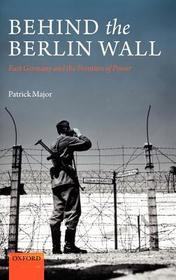
Behind the Berlin Wall
East Germany and the Frontiers of Power
- Publisher's listprice GBP 152.50
-
68 853 Ft (65 575 Ft + 5% VAT)
The price is estimated because at the time of ordering we do not know what conversion rates will apply to HUF / product currency when the book arrives. In case HUF is weaker, the price increases slightly, in case HUF is stronger, the price goes lower slightly.
- Discount 10% (cc. 6 885 Ft off)
- Discounted price 61 968 Ft (59 018 Ft + 5% VAT)
Subcribe now and take benefit of a favourable price.
Subscribe
68 853 Ft

Availability
printed on demand
Why don't you give exact delivery time?
Delivery time is estimated on our previous experiences. We give estimations only, because we order from outside Hungary, and the delivery time mainly depends on how quickly the publisher supplies the book. Faster or slower deliveries both happen, but we do our best to supply as quickly as possible.
Product details:
- Publisher OUP Oxford
- Date of Publication 26 November 2009
- ISBN 9780199243280
- Binding Hardback
- No. of pages336 pages
- Size 240x162x21 mm
- Weight 706 g
- Language English
- Illustrations 12 b/w illustrations, numerous maps 0
Categories
Short description:
On 13 August 1961 eighteen million East Germans awoke to find themselves walled in by an edifice which was to become synonymous with the Cold War: the Berlin Wall. Patrick Major explores how the border closure affected ordinary East Germans, from workers and farmers to teenagers and even party members, 'caught out' by Sunday the Thirteenth.
MoreLong description:
Few historical changes occur literally overnight, but on 13 August 1961 eighteen million East Germans awoke to find themselves walled in by an edifice which was to become synonymous with the Cold War: the Berlin Wall.
This new history rejects traditional, top-down approaches to Cold War politics, exploring instead how the border closure affected ordinary East Germans, from workers and farmers to teenagers and even party members, 'caught out' by Sunday the Thirteenth. Party, police and Stasi reports reveal why one in six East Germans fled the country during the 1950s, undermining communist rule and forcing the eleventh-hour decision by Khrushchev and Ulbricht to build a wall along the Cold War's frontline.
Did East Germans resist or come to terms with immurement? Did the communist regime become more or less dictatorial within the confines of the so-called 'Antifascist Defence Rampart'? Using film and literature, but also the GDR's losing battle against Beatlemania, Patrick Major's cross-disciplinary study suggests that popular culture both reinforced and undermined the closed society. Linking external and internal developments, Major argues that the GDR's official quest for international recognition, culminating in Ostpolitik and United Nations membership in the early 1970s, became its undoing, unleashing a human rights movement which fed into, but then broke with, the protests of 1989. After exploring the reasons for the fall of the Wall and reconstructing the heady days of the autumn revolution, the author reflects on the fate of the Wall after 1989, as it moved from demolition into the realm of memory.
Major's mastery of the archival sources is most impressive...a model of a truly integrated history...indispensable for anyone seeking to understand the origins and reality of the modern 'State With the Wall'.
Table of Contents:
Introduction
Part I: Before the Wall 1945-61
East Germany's Dual Crisis: Politics and Economics on the Eve of the Wall
Crossing the Line: Republikflucht between Defection and Migration
Holding the Line: Policing the Open Border
Part II: Behind the Wall 1961-89
Walled In: 13 August 1961
In the Shadow of the Wall
Wanderlust: Travel, Emigration and the Movement
Part III: Beyond the Wall
The Fall of the Wall: 9 November 1989
Seeking Closure: Remembering the Wall

