

- Publisher's listprice GBP 47.99
-
22 927 Ft (21 835 Ft + 5% VAT)
The price is estimated because at the time of ordering we do not know what conversion rates will apply to HUF / product currency when the book arrives. In case HUF is weaker, the price increases slightly, in case HUF is stronger, the price goes lower slightly.
- Discount 10% (cc. 2 293 Ft off)
- Discounted price 20 634 Ft (19 652 Ft + 5% VAT)
Subcribe now and take benefit of a favourable price.
Subscribe
22 927 Ft

Availability
printed on demand
Why don't you give exact delivery time?
Delivery time is estimated on our previous experiences. We give estimations only, because we order from outside Hungary, and the delivery time mainly depends on how quickly the publisher supplies the book. Faster or slower deliveries both happen, but we do our best to supply as quickly as possible.
Product details:
- Publisher OUP USA
- Date of Publication 16 June 2019
- ISBN 9780190868741
- Binding Hardback
- No. of pages248 pages
- Size 145x213x15 mm
- Weight 397 g
- Language English 0
Categories
Short description:
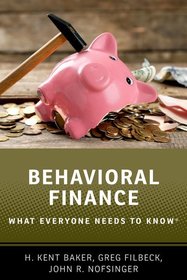
Behavioral Finance: What Everyone Needs to Know? provides an overview of common shortcuts and mistakes people make in managing their finances.
MoreLong description:
People tend to be penny wise and pound foolish and cry over spilt milk, even though we are taught to do neither. Focusing on the present at the expense of the future and basing decisions on lost value are two mistakes common to decision-making that are particularly costly in the world of finance. People are also tempted to throw good money after bad. Behavioral finance is the field that sheds light on how people make decisions and make predictable mistakes due to mental and emotional characteristics. It also provides insights into how markets operate. Having a better understanding of both can mitigate mistakes.
Behavioral Finance: What Everyone Needs to Know? provides an overview of common shortcuts and mistakes people make in managing their finances that can affect their wealth. An extensive discussion sets forth the cognitive biases or errors in thinking that occur when people are collecting, processing, and interpreting information. Emotional biases that can create distortions in cognition and decision-making are also covered, as are the influence of social factors, from culture to the behavior of one's peers. These effects vary during one's life, reflecting differences in cognitive ability due to age, experience, and gender effects. Of great importance is framing, how the presentation of a choice affects people's forecasts about the stock market, claiming social security benefits, savings behavior, mortgage choice, charitable contributions, and more.
Throughout the authors combine discussions of concepts, insights from research, and examples from recent events. Among the questions to be addressed are: How did the financial crisis of 2007-2008 spur understanding human behavior? What are market anomalies and how do they relate to behavioral biases? What role does overconfidence play in financial decision- making? And how does getting older affect risk tolerance?
If you are looking for a book that explains behavioral finance in plain understandable language, then this book is for you. This book adeptly applies the classic Socratic method to explain why the behavioral approach better explains the behavior of normal people than the neoclassical approach.
Table of Contents:
Chapter 1. Foundations and Psychological Concepts
Chapter 2. Cognitive Biases
Chapter 3. Emotional Biases and Social/Cultural Influences
Chapter 4. Investor Behavior
Chapter 5. Nudge: The Influence of Frame Dependence
Chapter 6. Cognitive Ability
Notes
Index

