

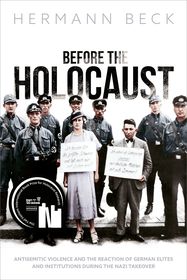
Before the Holocaust
Antisemitic Violence and the Reaction of German Elites and Institutions during the Nazi Takeover
- Publisher's listprice GBP 19.99
-
9 550 Ft (9 095 Ft + 5% VAT)
The price is estimated because at the time of ordering we do not know what conversion rates will apply to HUF / product currency when the book arrives. In case HUF is weaker, the price increases slightly, in case HUF is stronger, the price goes lower slightly.
- Discount 10% (cc. 955 Ft off)
- Discounted price 8 595 Ft (8 186 Ft + 5% VAT)
Subcribe now and take benefit of a favourable price.
Subscribe
9 550 Ft

Availability
printed on demand
Why don't you give exact delivery time?
Delivery time is estimated on our previous experiences. We give estimations only, because we order from outside Hungary, and the delivery time mainly depends on how quickly the publisher supplies the book. Faster or slower deliveries both happen, but we do our best to supply as quickly as possible.
Product details:
- Publisher OUP Oxford
- Date of Publication 31 October 2025
- ISBN 9780198985730
- Binding Paperback
- No. of pages572 pages
- Size 16x156x234 mm
- Weight 852 g
- Language English 667
Categories
Short description:
As the Nazis staged their takeover in 1933, instances of antisemitic violence began to soar. Hermann Beck examines the types of antisemitic violence experienced in the prelude to the Holocaust, as well as the reactions of the German institutions and elites who still had some capacity to protest these Nazi attacks, but often chose to remain silent.
MoreLong description:
As the Nazis staged their takeover in 1933, instances of antisemitic violence began to soar.
While previous historical research assumed that this violence happened much later, Hermann Beck counteracts this, drawing on sources from twenty German archives, and focussing on this early violence, and on the reaction of German institutions and the elites who led them.
Before the Holocaust examines the antisemitic violence experienced in this period - from boycotts, violent attacks, robbery, extortion, abductions, and humiliating 'pillory marches', to grievous bodily harm and murder - which has hitherto not been adequately recoqnized. Beck then analyses the reactions of those institutions that still had the capacity to protest against Nazi attacks and legislative measures - the Protestant Church, the Catholic Church, the bureaucracies, and Hitler's conservative coalition partner, the DNVP - and the mindset of the elites who led them, to determine their various responses to flagrant antisemitic abuses. Individual protests against violent attacks, the April boycott, and Nazi legislative measures were already hazardous in March and April 1933, but established institutions in the German State and society were still able to voice their concerns and raise objections. By doing so, they might have stopped or at least postponed a radicalization that eventually led to the pogrom of 1938 (Kristallnacht) and the Holocaust.
5* review: "...It is a book all students of the Nazi regime should read..."
Table of Contents:
Preface
Introduction: The Search for Archival Evidence
Part I: Violence against Foreign Jews
Violence against 'Ostjuden' in the Winter and Spring of 1933
'Ostjuden' as Predetermined Targets - a History of Marginalization
Attacks against American and West European Jews, among Others
Part II: Violence against German Jews
Violent Attacks
Pillory Marches and the Perfidy Decree
Murder
Boycott
Legal and Economic Discrimination
Part III: Reactions to Anti-Semitic Violence
The Protestant Church and the 'Jewish Question'
Protestant Church Leaders and the 'Jewish Question'
The Protestant Church between Action and Silence
The Reaction of the Catholic Church
Reactions of the German Bureaucracy
The Reaction of Hitler's Conservative Coalition Partner
Epilogue: How could it happen?

