

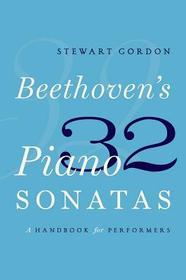
Beethoven's 32 Piano Sonatas
A Handbook for Performers
- Publisher's listprice GBP 36.49
-
17 433 Ft (16 602 Ft + 5% VAT)
The price is estimated because at the time of ordering we do not know what conversion rates will apply to HUF / product currency when the book arrives. In case HUF is weaker, the price increases slightly, in case HUF is stronger, the price goes lower slightly.
- Discount 10% (cc. 1 743 Ft off)
- Discounted price 15 689 Ft (14 942 Ft + 5% VAT)
Subcribe now and take benefit of a favourable price.
Subscribe
17 433 Ft

Availability
printed on demand
Why don't you give exact delivery time?
Delivery time is estimated on our previous experiences. We give estimations only, because we order from outside Hungary, and the delivery time mainly depends on how quickly the publisher supplies the book. Faster or slower deliveries both happen, but we do our best to supply as quickly as possible.
Product details:
- Publisher OUP USA
- Date of Publication 2 March 2017
- ISBN 9780190629182
- Binding Paperback
- No. of pages288 pages
- Size 234x157x20 mm
- Weight 476 g
- Language English 100
Categories
Short description:
In Beethoven's 32 Piano Sonatas, renowned performer and pedagogue Stewart Gordon addresses textual issues, Beethoven's pianos, performance practices, composer's indications, and the composer's development, pointing to patterns of structure, sonority, keyboard technique, and emotional meaning. In addition, each sonata appears in a helpful outline-chart format for easy-access reference.
MoreLong description:
The thirty-two Piano Sonatas of Ludwig van Beethoven form one of the most important segments of piano literature. In this accessible, compact, and comprehensive guidebook, renowned performer and pedagogue Stewart Gordon presents the pianist with historical insights and practical instructional tools for interpreting the pieces.
In the opening chapters of Beethoven's 32 Piano Sonatas, Gordon illuminates the essential historical context behind common performance problems, discussing Beethoven's own pianos and how they relate to compositional style and demands in the pieces, and addressing textual issues, performance practices, and nuances of the composer's manuscript inscriptions. In outlining patterns of structure, sonority, keyboard technique, and emotional meaning evident across Beethoven's compositional development, Gordon provides important background and technical information key to understanding his works in context. Part II of the book presents each sonata in an outline-chart format, giving the student and teacher ready access to essential information, interpretive choices, and technical challenges in the individual works, measure by measure, all in one handy reference source. In consideration of the broad diversity of today's Beethoven interpreters, Gordon avoids one-size-fits-all solutions or giving undue weight to his own tastes and preferences. Instead, he puts the choices in the hands of the performers, enabling them to create their own personal relationship with the music and a more powerful performance.
This friendly, helpful, refreshingly nondoctrinaire guide to performing Beethoven is quite far from what appears to be a hornets nest atmosphere in American musicology today. It is addressed to thinking pianists who wish to make up their own minds about what Beethoven may have wanted in his sonatas. It is a book of choices, reasonably argued.
Table of Contents:
Preface
Measure Numbering
Part I
Considerations
Chapter One: Sources
Chapter Two: Beethoven and the Piano
Chapter Three: Performance Practices
Chapter Four: Beethoven's Expressive Legacy
Chapter Five: The Windmills of Beethoven's Mind
Part II
The Sonatas
The Opus. 2 set
Opus 7
The Opus 10 set
Opus 13 "Pathétique"
The Opus 14 set
Opus 22
Opus 26
The Opus 27 set: sonatas like a fantasy; no. 2 "Moonlight"
;Opus 28 "Pastoral"
The Op. 31 set: no. 2 "Tempest;" no. 3 "Hunt"
The Op. 49 set: Two "Easy" sonatas
Opus 53 "Waldstein"
Opus 54
Opus 57 "Appassionata"
Opus 78
Opus 79 "alla Tedesca"
Opus 81a "Lebewohl"
Opus 90
Opus 101
Opus 106 "Hammerklavier"
Opus 109
Opus 110
Opus 111
Bibliography

